


John Ball
Forum Member
-
Joined
-
Last visited
Everything posted by John Ball
-
Hi John949. The answer to your first question is covered in the WS Call Book for Radio Sailing Call B10 which says in part As the windward boat, W has an obligation to keep clear under rule 11 throughout the incident. The boats are overlapped when they enter the 4-lengths zone and, from that moment, W is required by rule 18.2(b) to give mark-room to L. However, L is unable to fetch the mark and is not entitled to room to tack in order to pass the mark on the required side. Therefore W's only obligation is to keep clear, which she does. Neither boat breaks a rule. After W rounds the mark, the boats are on different legs and both are required by rule 23.2 not to interfere with each other, except when sailing their proper course. However, while the boats remain on the same tack, W must continue to keep clear of L under rule 11. This applies even if W is sailing her proper course. If L causes W to alter course, L interferes with a boat sailing on another leg and she breaks rule 23.2. The answer to your second question - does inside boat lose R 11 rights - the answer is definitely NO. See the preamble to Part 2 on the RRS which says SECTION A RIGHT OF WAY A boat has right of way over another boat when the other boat is required to keep clear of her. However, some rules in Sections B, C and D limit the actions of a right-of-way boat. The ROW rules are in Part 2, Section A. They are R10 through R 13. They always apply. However some of the other rules of Part 2 may require a ROW boat to give room or mark room - so they do not turn off ROW but may restrict the action of the ROW boat. John
-
John949 asks above Is rule 18 actually relevant here? Isn't the situation covered by Rule 11 W/L and Rule 13 Tacking? How fast yellow is allowed to luff is governed by Rule 17. Hi John, Yes - absolutely R18.2(b) applies here as drawn. Yes, Green has to keep clear under R 11, but one important aspect of being granted Mark Room, is that you are exonerated under R 43 if you break R16.1 or 17, as long as you are sailing within your proper course to the mark. - That could include luffing up to head to wind to squeeze around the mark. You are also correct that if Yellow passes head to wind, she loses her R 18 rights, and is now tacking, and subject to R13. But this is not as drawn - note Yellow has not passed head to wind. John
-
Hi Trevor As you gain experience, you will recognize that you are going to be in trouble with other boats as you approach the mark, especially if you are to the left side of the course. Yes, get to the right and get above the lay line six to ten boat lengths from the mark. If there are other boats on the lay line, hold high, but if there is a gap, you can reach off towards the mark with speed. You may find my web site, Chapter 3 R18 and the WIndward Mark useful - especially the first few pages which cover setting up for the mark.. https://sites.google.com/site/johnsrcsailingrulesandtactics/ John
-
Hi Trevor, Below is a generic diagram that shows the problem for the leeward boat, Yellow. The rules that apply are 18.2(b) and 18.2(d), plus R 11. The two boats enter the zone, overlapped on stbd, and Green has to keep clear R11 W/L, and as Yellow is inside boat, is entitled to mark room 18.2(b). She may luff up to try to head reach around the mark, and in order to give that mark room, Green must stay clear. In the diagram, I show Yellow luffing and Green responding However, mark room for Yellow ends if she passes head to wind R18.2(d). At this point she becomes the keep clear boat. So bottom line, Yellow cannot ask for room to tack. She is stuck, below the lay line and can either slow down and then tack behind Green, or bear away and gybe around - her choice. John

-
Hi Derek, I am trying to imagine what you mean here - if a boat bears away and runs into you - they have probably broken R 11 (W/L) and there is no requirement for you to give them any room or opportunity. John
-
Hi Brad and Derek, This is a great question and it applies to any country. I think the answer for IOM is in the IOM Class Rules. It would be valid if the MNA granted a certificate, otherwise, NO, must be measured by an MNA appointed measurer. John G.2.2 CERTIFICATION (a) Except where sails are certified as in (b) the official measurer shall certify sails in the tack and shall date each with the date of certification control. (b) An MNA may appoint one or more persons at a sailmaker to certify sails produced by that manufacturer. A special licence shall be awarded for that purpose. International One Metre Class Rules 202
-
Hi Rohan, I have created a couple of diagrams - the overlap starts as soon as the bow of Green reaches a line drawn square off the transom of Yellow. In the upper diagram, the overlap at P2 is too close - even to the point that as Green moves forward and Yellow sheets in her sails to start to respond, Green could be trapped by the boom of Yellow. In the lower diagram, it looks like room is given. A hail of 'stay up' is quite appropriate. If Yellow does not respond, then hail protest at the time of the incident. For more info on how to protest, see Chapter 7. The Protest. John Sufficient room.pdf
-
Hi Rohan, the rules to read are 11, 12, 15, and 16.1. R17 does not apply before the start. You may find Chapter 2 STarts on my web site useful https://sites.google.com/site/johnsrcsailingrulesandtactics/ When a boat is sitting just below the line and another boat approaches from astern, the boat astern has to keep clear. R12. When the approaching boat establishes a leeward overlap from astern, the rule changes and R11 applies and the now windward boat must keep , however as ROW changed, the windward boat initially must have room to keep clear R15. Once room has been given and as R 11 applies, W must keep clear, but if L wants to luff up a bit to push W over, then R16.1 applies as L with ROW changes course and again W must be given room. John
-
Hi Ian, The concept of 'advantage' comes up in taking penalties. Running aground is not against the rules - so no penalty implication. When refloating a boat, you may not give it a strong push, as that would break R 42 Propulsion. If a boat is able to take a risky path and cut a corner and risk running aground, but a quick recovery gets the boat back into the race with an advantage, then that is a race management issue, and the RC needs to think about how the course is set, and maybe declare an area as an obstruction (no-go). John
-
Hi Michael, the boat is only disabled while she is aground. Once she has been released, she is no longer disabled and may continue to race. There is no rule that says that once you are disabled, you must retire, except for the hail of 'out of control' John
-
Hi Michael, pushing off your own boat is not outside help - so no rule is broken. See E3.1 Yes, the boat is disabled, so the RC may help (E4.2(c)) by sending a rescue to relaunch or even by directing another party (who becomes an extension of the RC) to help. John
-
HI Trevor, That's great as the sound files on the RMG web site would not work for me. I have saved them on my computer. However, which is which REV. John
-
No it would not be considered outside help as described in E4.2- it would have been considered as a witness to an incident. John
-
While john949 describes a protest hearing, John Taylor's problem is that the umpire made a decision and awarded a penalty. Usually regattas that use Umpires are set up as 'no appeal' against a decision of the umpire. So John has no recourse. However, if the Umpire recognises that they made an error - they can notify the RC under 62.1 as an error or omission. Then the RC may call a request for redress under 60.2 Then a redress hearing may consider the events and make a new determination. John
-
Hi John, cannot comment on your scenario, but here is what I think should happen. One boat hails Protest. The incident is not seen by an observer, nor the Umpire. The other boat does not take a penalty. The umpire cannot make a decision as they have no facts. The umpire has only a short time to react - and with no facts, should hail 'No Decision'. What you have is an 'unresolved incident' and that should go to a protest hearing. Here is a link to the IRSA Addendum Q for Umpired Racing. https://www.radiosailing.org/documents/administration/category/276-umpiring?download=440:irsa-rules-for-umpired-racing-2020 This document is being replaced by a new World Sailing document called 'Test Rule for Umpired Radio Sailing'. I am not sure what its publication status is, but the essential actions are the same in each document. John
-
This is how we do our scoring. It is a two part process. We score the weekly race day as normal. We run a second copy for the series, where the top boat for race day 1 is scored first, and so on , then next week become Race 2. The program we use is called Afleet ( from NZ), and it runs on an Android phone or tablet and is designed for RC sailing. https://afleet.app/ The current version is for just one fleet, but the beta version (available by special request) supports a multi-fleet hms style scoring. Both work fine and are easy to use. You can output the results as a pdf and transfer to a shared google drive, or upload to your local club web site. It is quite fully featured, for redress, dnf, dsq etc, and discards can be customised, but default to after 4,8, and every 8 thereafter. John
-
The rule 16.1 is the easy part - Yes, when a ROW boat alters course, it must give 'room'. Room is defined as room to avoid in a seaman-like manner. Seaman-like is described in WS Case 103 as room for an experienced but not expert crew. The WS Call Book for Radio Sailing General Principles #1 through 4 and especially, #3 also says that while an RC boat can manouver faster, you still have to allow time for the skipper to see what is happening, and to decide that an action is to be taken, and then start to take it. So while the rule part is easy, establishing the facts to apply the rule is harder. we are hearing only one side of the incident, and you say 'quarter of meter, and alters course sharply'. If those facts are established by a Protest Committee, it sounds reasonable to find that sufficient room was not given. John
-
Not quite - the IOM class rules require that the panels of an individual sail be of the same material (ply) , but you may use different material for main and jib. John
-
While 44.1 refers to the series, E4.3(b) does not. So in radio sailing, just the heat or race. John
-
Hi John As a newish RC sailor, have you visited my rules and tactics site - it may help https://sites.google.com/site/johnsrcsailingrulesandtactics/ As you your comment about 'seamanlike', that only kicks in when 'room' comes into play - eg when an ROW boat alters course, does the keep clear boat have 'room'? So when Yellow alters course to circle back, does she give room for a keep clear boat? It appears Yes, as drawn. Once Yellow gains mark room over Red, under R 18.2(a) she would be exonerated for any breach as long as she is sailing within the room permitted by her proper course - and that include room to avoid Green. John
-
Hi again John, Here is a diagram for your second question re missing the downwind mark. Here Yellow enters the zone clear ahead of Green and Red and is entitled to mark room R 18.2(b). However she turns short of the mark and circles back, passing head to wind at P4. At that point the previous mark room ends. However when Green enters the zone and become overlapped inside Yellow by P5, R 18.2(a) applies and Yellow gives mark room to Green. Red also enters the zone already overlapped with Green and gives Green mark room (18.2(b) and becomes overlapped outside Yellow by P5 and has to give mark room to Yellow R 18.2(a). John

-
The diagramming program is called 'boats.exe' It is available for free download from http://boats.sourceforge.net/ It has a short learning curve, but overall is easy to use. You wrote for your second question in a similay vein, what about mark room if you accidentally sail inside a downwind mark and tack to go back and round it correctly? Obviously you have to keep clear while tacking but once you have completed the tack, are you still entitled to mark room from boats which were clear astern when you entered the zone (and you haven't left it)? To enlarge on my previous answer, as you tacked in the zone, any existing mark room expires. As you are in the zone after the tack, and another boat enters the zone, R 18.2(a) will apply , as 18.2(b) does not apply. So as you become overlapped the inside boat gains mark room. John
-
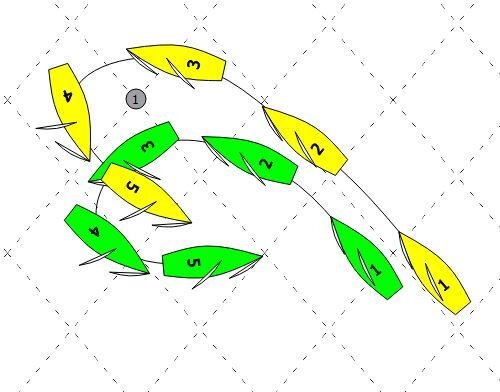
Hi John, it always helps to provide a diagram. I have made one that I think represents your incident. The answer is that Green has broken no rule (ie did not hit mark and was not doing a penalty turn). so it is her proper course that counts. Green's proper course is to come up to close hauled to get back to the mark and Yellow as windward must keep clear. R 23.2 and R 11. On your second question, once the returning boat tacks (or leaves the zone), the original mark room ends. R 18.2(d)
-
I suggest you read Call P4 in the World Sailing Call Book for Radio Sailing (formerly the IRSA Case Book). As P did not gain any place ( or advantage) by her infringement, her penalty is completed after one penalty turn. John
-
A possible cause is insufficient prebend in the mast. If you have too little prebend, then you only have a little backstay tension to bring the mast straight. With just a little tension from the backstay which transfers to the forestay, the rig does not generate enough tension on the topping lift. John

