John Ball
Forum Member
-
Joined
-
Last visited
Everything posted by John Ball
-
Adding to Lester's comments, I use the shank of a drill bit as spacer, add an extra twist to the first part of the knot - the extra friction holds it in place while tying the second half.. Then a dab of crazy glue to lock the knot, and finally trim the ends. John
-
Here is a guide for sailing IOMs in salt water - same precautions should apply to DFs. John radio-control-sailing-in-saltwater-v2.pdf
-
Just to muddy the waters - The class rules for all three active IRSA international classes (IOM,10R, M) follow the same general format for their class rules, and give jurisdiction for measuring to the recognised national authority in each member country. The format is structured to reflect the Equipment Rules of Sailing (ERS). Section A for each of the Class Rules use BOLD type as a reference to defined terms in the ERS and all three classes use the term Official Measurer. I have found an anomaly - the issue is that the term Official Measurer is not a defined term in the ERS. The defined term in ERS is Certification Measurer. The wording is consistent with what we would intend for an official measurer but is not identified correctly. I have reported this discrepancy to the IRSA to verify and to follow up with the ICAs. From the ERS C.4.4 Certification Measurer A person appointed or recognised, by the MNA of the country where the control takes place, to carry out certification control and when the class rules permit, certification. An MNA may have delegated this responsibility. John
-
Hi Michael, this question was discussed on the IOMICA forum. Essentially you are asking about IOMICA licenced 'Certified Sailmakers' https://www.iomclass.org/phpBB3/viewtopic.php?p=13188#p13188 If you do not have access, here is the question and the answer. John Certified sailmakers Post by Art Prufer » Sun Feb 15, 2026 9:02 am According to this rule: G.2.2 CERTIFICATION (a) Except where sails are certified as in (b) the official measurer shall certify sails in the tack and shall date each with the date of certification control. (b) An MNA may appoint one or more persons at a sailmaker to certify sails produced by that manufacturer. A special licence shall be awarded for that purpose. AND ON THE RIG MEASUREMENT FORM: MAINSAILS 31. G.2.2(b) If the sails have been certificated by a manufacturer awarded a special license, then omit steps 32 to 60 HEADSAILS 60. G.2.2 (b) If the sails have been certificated by a manufacturer awarded a special licence, omit steps 62 to 86 Where can we get the list of manufacturers who have been awarded this special licence, and what sail markings are required to indicate that they have been 'pre-certified' ? Last edited by Art Prufer on Mon Feb 16, 2026 12:53 pm, edited 1 time in total. Art Prufer CRYA #1189 Can 42 and the answer from IOMICA Andrew Crocker Vice-chairman (Technical) Re: Certified sailmakers Post by Andrew Crocker » Thu Feb 19, 2026 1:45 pm Hi Art, Thanks again for your question. The short answer is that there are no licensed IOM class sailmakers in the terms of Class Rule G.2.2(b). G.2.2(b) was adopted into the IOM Class Rules from the World Sailing Standard Class Rules (SCR) and refers to the World Sailing In-House Equipment Certification (IHC) programme – see https://www.sailing.org/inside-world-sa ... ification/. At present, the International One Metre class is not a participating class association and, given the way in which the IHC programme operates, it is difficult to see how it would be feasible. As a result, there are no certified IOM sailmakers. The VC Measurement is reviewing this process with a view to making it more relevant for IOM sailmakers and owners. Regards Andrew
-
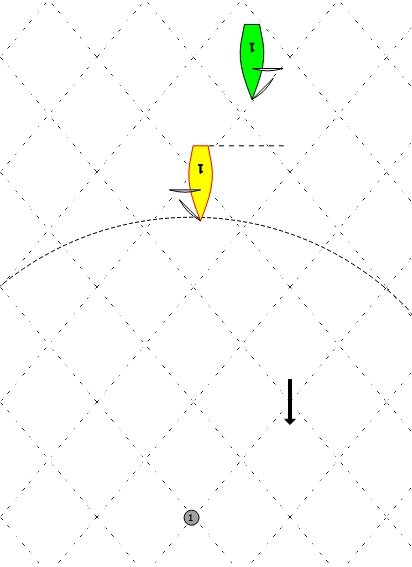
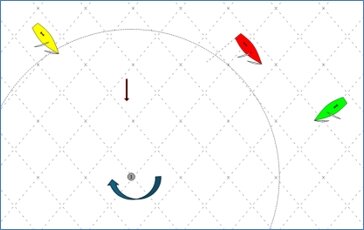
Hi Larry, and thanks for the kind comments, Sorry if this sounds pedantic, but R 18.2 wording changed for the current RRS to remove an anomaly. Under the previous version of the RRS, the boat clear ahead gained mark room, but the new wording says essentially, 'when not overlapped, the boat that reaches the zone first' gains mark room. The first diagram shows a 'normal' downwind mark with Yellow clear ahead and gains mark room. The second diagram is taken from my web site article on 'Tactical Roundings and Proper Course', See chapter 5 Bonus item, and shows the new wording in action - here we need to assume that the boats are sailing a higher angle that normal, say in lights winds. Here, Green is clear ahead of Yellow yet Yellow gains mark room under the new wording of 18.2, as she reaches the zone first. John
-
Hi Colin, when we were referring to proper course above, it was in the context of 71 with mark room, sailing close to the mark. When 71 altered course to follow 86 around the mark, she was on a reach, to sail close to the mark. 23 was not entitled to get between 71 and the mark and not prevent 71 from rounding the mark. 71 did not 'close the door' - there never was an opening - just 23 sailing straight on and hitting 71. Proper course while two boats are overlapped comes up if/when R 17 applies. If a boat sailing close hauled established an overlap from astern and to leeward, she must not sail above her proper course - however if she can point higher than the windward boat, that is her proper course, and windward must stay clear, which may require windward luffing a bit or even tacking away to avoid breaking R 11. John
-
Hi John949. Yes I agree. If room is left, a trailing boat without mark room takes it at her own risk - see WS Case 63. When 71 alters course to sail close to the mark, she was sailing her proper course 'close to the mark' as the next leg was a beat. One rule we did not mention in this scenario, is that when 71 altered course, and may break R 16.1, she is exonerated under R 43, as she was sailing within the mark room to which she was entitled. 71 did not break R 14. When 23 broke R 18.2, she also broke R 14 as she failed to avoid 71, but gave 71 no chance to avoid her. You can only be DSQ once even if breaking several rules in a single incident. John
-
You guys seem to enjoy finding weird questions. This is my opinion. There are a lot of ‘NOTs’ in this question. The boat you hit was not racing. The boat was not part of the mark (see definition of mark). The boat you hit was an obstruction, but there is no rule about hitting an obstruction (just about giving room to anther boat that is racing). As the boat was not racing, R 18 does not apply. The preamble to Part 2 says that the tangled boat was intending to race, so the RRS may apply. It is possible that you broke R 14 however the tangled boat moved, hitting you without giving you room to avoid but you should still have stayed more clear. As you did a penalty turn, there is no further penalty. John
-
Hi Womble66 - thanks for providing additional info not available before (a gate mark). Here are my comments. These comments may help anyone on a future protest situation at a downwind mark. The facts must establish that this is a downwind mark and possibly as part of a gate. These days, most events seem to use a downwind gate, so R 18.4 would not apply. In this scenario, R 18.4 did not apply as the boats did not need to gybe to round the mark. Q1 ‘which boat had mark room when the first boat reached the zone’? Q2 ‘did that boat do anything to end its mark room ie leave the zone or tack in the zone’? Q3 ‘was the mark room boat sailing within her proper course provisions’? Q4 ‘was the boat owing mark room herself entitled to mark room from a third boat and was that room given?’ The answers to these questions would resolve the incident in the youtube video. Q1 – Yes, boat 71 was clear ahead at the zone and entitled to mark room from the boats astern, Q2 – No, 71 did not leave the zone nor tack in the zone so mark room continues. Q3 – Yes, 71 sailed directly to the mark while providing mark room to 86. As she was sailing within her mark room, 71 would be exonerated for any breaches of Part 2, or R31. Q4 – Yes, boat 23 was owed mark room by 164. And unless evidence is presented by witnesses, it looks like that room was given. If there was evidence that 164 prevented 23 from passing astern of 71, then 23 may be exonerated and 164 would be DSQ. If 164 gave room, then 23 is DSQ. John
-
Hi Colin the 'how long' is easy - while mark room exists. See the definition of Mark Room and R 18.2(b). And for your comment about a poor rounding and space being given, see WS Case 63, where you take such room 'at your own risk'. But in this example, 71 was sailing close to the mark and there was no opening to sail into - perhaps an issue with depth perception but poor sailing non the less. John
-
Hi Olivier, I think I understand why it took so long - there were two boats directly involved, and three boats that were at least witnesses or more seriously, parties to the protest, so that takes time to hear each person. John
-
Thanks John and Olivier. I agree with you, however we do not know what claims were made by the skippers at the protest hearing that could have led to a long discussion. I think the main take-away is that if a boat is clear ahead approaching the zone, ANTICIPATE that you will have to give her mark room, so plan to be able to pass astern – and if that requires that you hail any boats around you to provide that room – do it early. If you are the mark room boat, protest if you are hit. If you are the trailing boat and hit a boat with mark room – then take a penalty turn – that will cost less pain than being DSQ in a hearing and save everyone time. I have attached a write up of the incident including some screen grabs, and have created a diagram that a Protest Committee may have constructed to arrive at a decision. John Incident at downwind mark.pdf
-
Here is an incident posted on youtube by Nick Lindsley from AUS which I think could happen on any race course. From the description, this went to a protest hearing that unfortunately lasted an hour without a resolution, and racing was delayed. We do not know if the PC had access to or used this video, nor do we know if it was recorded from the control area, so it may contain a perspective that was not available to the skippers so it may not have been admissible. I think there are some ‘learning’ opportunities here, so please watch the video and try to figure what happened and which rules may apply. We are not second guessing the Protest Committee here, we are looking at the incident to learn which rules may apply so a similar incident may be avoided in the future. https://www.youtube.com/watch?v=HovEu7cXH5g I’ll come back later with some comments. John
-
HI Simon, and yes, Wayne is correct. I cover this in my chapter 2 The Start and see page 7. https://sites.google.com/site/johnsrcsailingrulesandtactics/ By default, the RRS Appendix E 3.4 says E3.4 Starting and Finishing (b) The starting and finishing lines shall be between the course sides of the starting and finishing marks. The exception would be if the Race Officer announced something different as the Skippers' Meeting when describing the course marks. John
-
Hi Colin, my thoughts are that for scenario 1, boat A passed HTW from port to STBD, but did not reach a close hauled course, so is still subject to R 13 and must stay clear of C. For scenario 2, from discussion with judges, R 21.3 (sailing backwards) does not apply as the boat has no crew to 'back a sail'. so it does not apply to just drifting backward. If we say that the leeward/ahead boat Boat A luffed up towards HTW (but not passed), then she is still on stbd, but her action in luffing up (over-stuffing in your words) is a ROW boat altering course, then 16.1 applies, and she must give room to C to stay clear. John


-
Second thoughts - my answer above covers the mechanics of the incident - how to get there and how to score it, but what is the cause? what is the real issue? Does this skipper not understand the rules? Does he need some help and coaching? Or is this a recurring and complete disregard for the Corinthian spirit of racing and a willingness to respect the rules and the rights of other competitors? If yes, then a last resort - a PC may want to consider an R 69 hearing. John
-
I think that it would take a protest committee to upgrade the offense to breaking R 2 Fair Sailing to be able to upgrade from DSQ to DNE. The PC would need to find that repeated breaking of the (same) rules met the standard of R2. John
-
Remember that HMS and Afleet treat the 1st race as a seeding race unless told otherwise - so assuming that you have set to single fleet so that seeding is not active, all races should be counted and the last time I checked, HMS and Afleet both compute AVG including all finishes - they don't do the discards and then compute the AVG of the remaining races. Once they have computed your AVG, then they apply the discards to compute your score. I assume this was a race management decision when HMS was created. Also a comment, for 7 races there is only 1 discard. The second discard is after race 8. John
-
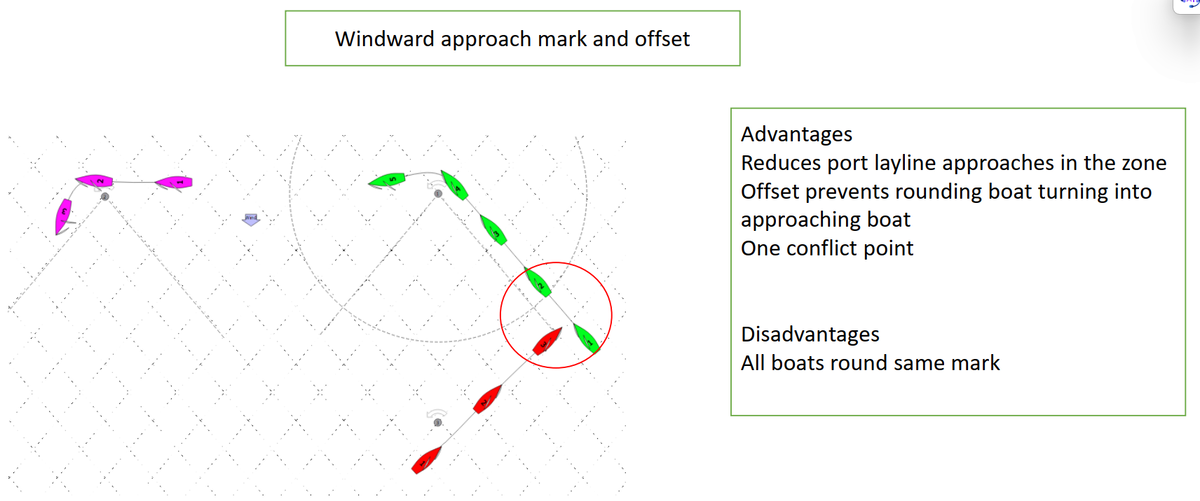
I suggest another option for consideration - use a wind mark and offset mark with the addition of a windward approach mark. The approach mark would be set about 6 boat lengths to leeward of the windward mark and have a required side that all boats must pass it to port. The idea is that boats coming in from the left side of the course on port, would be encouraged to get on the stbd lay line sooner, and if possible, outside the zone. John

-
I recommend against charging Lipo or Life batteries in the boat- risk of explosion or fire. I always use a charging safety bag. John
-
Try moving the winch plug on the Rx from CH 3 to CH2. Then move the right stick up and down. Has the glitching gone away. If yes, then it could be the pot on left stick of the Tx. If not, then it could be corrosion on the plug on the winch or the winch. John
-
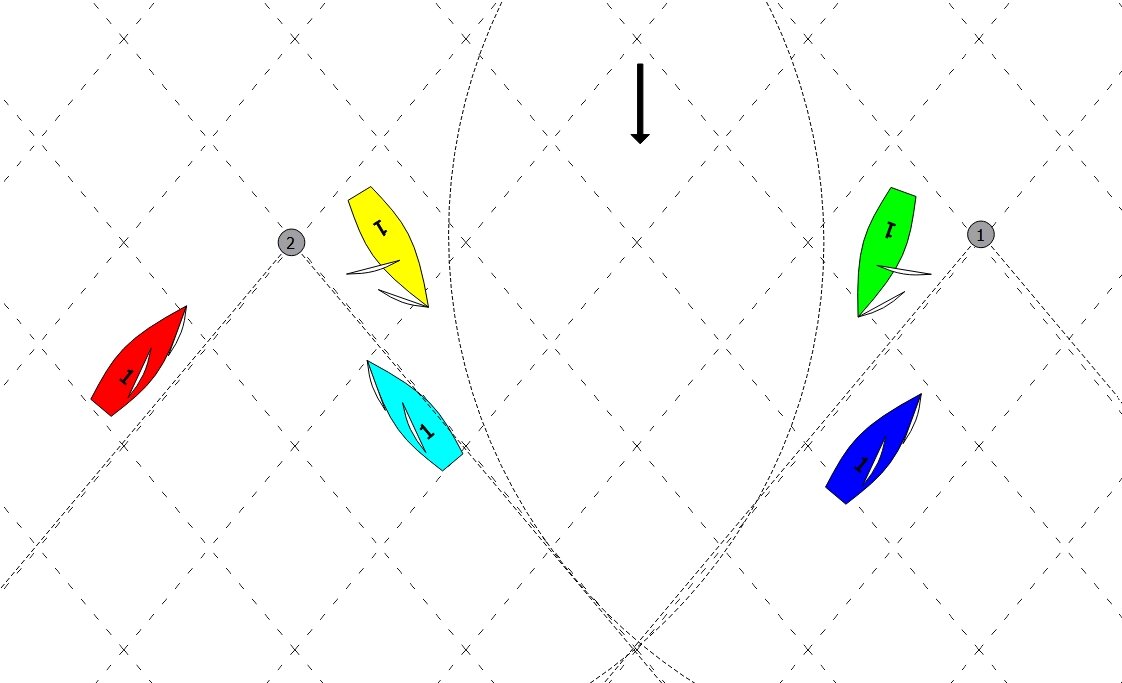
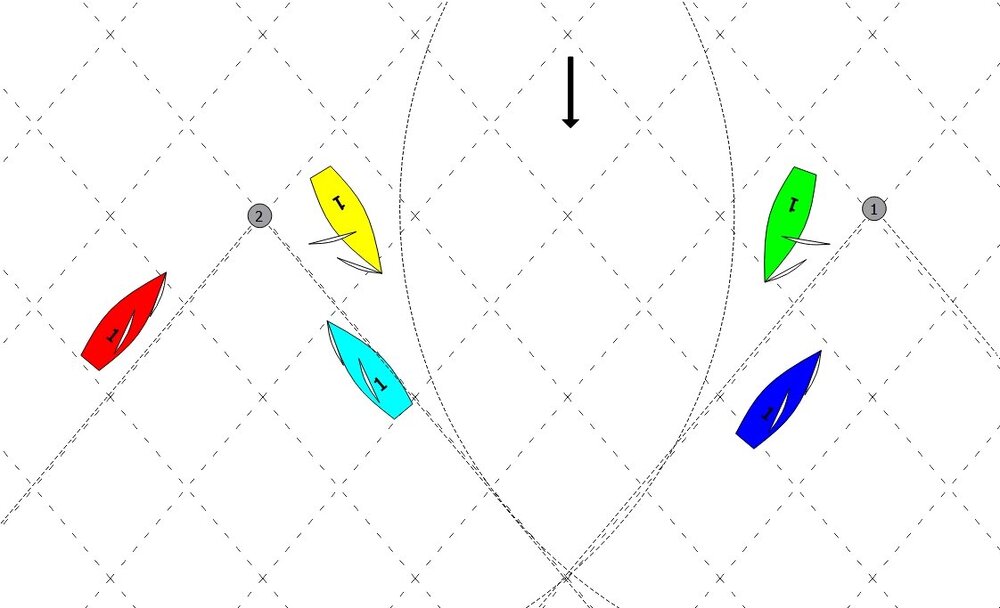
Outside-in gate at the windward mark - by John Ball Thanks and congratulations to the sailors, IOMICA, MYA, and the volunteers who put on a great show at the 2026 IOM World Championship at Datchet Water, UK. The windward mark. Initially, we saw the conventional windward mark with an offset, but many boats arrived together, on both starboard and port tacks and there were many incidents. The RC switched to an outside-in windward gate. The outside-in gate has one big advantage – it usually splits the fleet over the two marks, reducing congestion, but it also has one big disadvantage – there is no longer an offset mark to separate the boats rounding and bearing away from the boats still approaching each mark. Look at the diagram, below. Boats rounding the right-hand mark – mark to port, is quite conventional, with the proviso that while the boat bearing way is on stbd and has ROW over an approaching port tack boat, the stbd tack boat is subject to R 16.1 as she alters course. Green cannot just turn down and interfere with Blue. As they are on different legs, R 23.2 also applies, and the ROW boat is not interfering IF she is sailing her proper course. Boats rounding the left-hand mark – mark to stbd, has all the issues of a stbd rounding – see my web site https://sites.google.com/site/johnsrcsailingrulesandtactics/ and Chapter 3 bonus item – ‘Weather Mark – the ‘Dreaded Marks to Stbd’, but with no offset, they have the additional problem that they are on port and as they bear away to the run, have to stay clear of any approaching stbd tack boats. Yellow has to stay clear of Pale Blue. As they are on different legs, R 23.2 also applies, and the ROW boat is not interfering IF she is sailing her proper course. John
-
Many thanks John
-
It would be nice if the camera control switched to cover the front boats - we get left watching back markers round a mark while Nigel's commentary has moved way down the course. Just watched Race 6 - much better tracking of the lead boats John
-
I think it is a Triple Crown. Flare at the bow, and max beam aft of the middle of the boat. John