


Everything posted by John Ball
-
Wide in-close out is a function of having ROW and is not related to Mark Room. So should be no difference. So if you have Mark Room and the other boat has to keep clear under R 10, R 11 or R 12, you may still do the wide in-close out. So in your example of a port tack windward boat, they were never entitled to wide in - just enough room to round the mark in accordance with the definition of Mark Room and Room R21 only provides protection if you are sailing within the Mark Room or Room to which you are entitled - so if you get greedy and sail wide, affecting a ROW boat, you loose the protection of R 21 John
-
You may also find my articles helpful. They cover the basics, and then lead you around the race course covering both tactics and the rules. http://crya.ca/information/rules-tactics/ John
-
I have used this product Gold-N-Rod a tube in tube system that is flexible. https://www.sullivanproducts.com/GoldnRodContent.htm John
-
Here is the link http://www.sailing.org/tools/documents/WorldSailingRRS20172020-%5B20946%5D.pdf Appendix E has several changes. Addition of Code Flag U ( a less severe version of Black Flag) Recognition of 'Disabled Competitors' and make equal arrangements. More detail in 'Outside help' Deletion of the words 'and as a result, retiring' from Redress. Change to E8 sail Numners. The old E8.b.2 to drop the leading zero in the range 00-09 has disappeared, so we are back to two digit sail numbers. John In the main part of the RRS, some changes are listed here (from Sailing Anarchy) Outside Appendix C (match racing), AFAICS, no major changes, particularly to part 2. it's mostly housekeeping. Definitions now include one for "support person". Rules: Penalty for breaking rule 2 can now be DSQ or DNE. 3 (Acceptance of rules) completely re-written. Includes support people New rules 6 and 7 - betting/anti corruption & disciplinary code. Part 2 preamble: boats can now be DSQ for breaking 14 and causing injury or serious damage (as well as 24.1) when not racing. New 18.2.d Rules 18.2(b ) and (c ) cease to apply when the boat entitled to mark-room has been given that mark-room, or if she passes head to wind or leaves the zone. (Old 18.2.d and 18.2.e renumbered e and f respectively). 18.3 Only applies at port hand marks. New 19.1.b Rule 19 applies between two boats at an obstruction except (b ) when rule 18 applies between the boats and the obstruction is another boat overlapped with each of them. 20. Re-written. Now states when boats may hail, rather than when they shall not. 21 now part of section D, no longer refers to section C. 22.3 applies to boats moving sideways to windward by backing a sail. 24.2 rewritten. Now "if reasonably possible". 30.3 New "U flag" rule. Aka a black flag that doesn't carry over if the start is general recalled. Black flag is now 30.4. 32.1. Can now shorten to allow time for subsequent races, and can only abandon for starting errors. 32.2 Can now shorted at a line that boats have to cross. 40 - Y ashore = PFDs when afloat at all times. 44.2 Scoring penalty now 20% of DNF score (not entries, as before). 49.1 now refers to when lifelines are required by class or any other rule.(not just SIs) 55 Trash. Penalty now discretionary. 60.4 New rule. Technical committees may protest. 60.5 However, neither a boat nor a committee may protest for an alleged breach of rule 5, 6, 7 or 69. 61.1.a.4 No flag required if the crew is in danger. 53.4 New rule - conflict of interest. 63.7 Broadened to conflict between rules, not just NoR & SIs. 64.3 - housekeeping on class rule protests. 64.4. New rule: Decisions concerning support people. 69 Rewritten. 78 Housekeeping. 84, 85, 86 housekeeping. Appendix C Big changes: 17 deleted completely, 18 now the test rules. Appendix D 17 has not been deleted, contrary to much rumour.
-
I have been thinking about this question and have some thoughts. First, the IRSA needs the RG65 more than the RG65 needs the IRSA. The IRSA is responsible for the four International classes. However the A Class is too big and heavy for transportation around the world for International World Championship Regattas and has already been downgraded to Historical status. The 10R is also very large for transport. Both these two classes and the M are great for Europe and for Continental Championship regattas where you can drive to the event and transport the boat and rigs in your car. Australia and North America are huge and the driving distances are so great that they are unlikely to see a large support. The IOM is small enough and (with some difficulty and risk) rig boxes may be taken on a plane, but are usually FedEx’ed to and from a long distance regatta. The only really active International class over the last 15 years has been the IOM Class. It is great that the M is again hosting a World Championship. So the IRSA needs a new ‘portable’ class that may be easily transported by air. The RG65 Class has some problems. I could not find whether or not is has been ‘legally’ constituted as a Not-for-Profit organization in any jurisdiction. Nor could I find a Constitution and Bylaws to cover Executive Officers and Directors, or how to nominate such officers, or how to propose class rule changes or how to vote. If my suspicions are correct, then the RG65 is not yet a real ICA, just an idea. The English version of the Class rules have some wording problems – eg use of SHOULD when SHALL is more appropriate. SO there is room for improvement. If the RG65 ICA votes No to joining the IRSA at the present time, as seems likely from the feedback, then to me it would be unconscionable for the IRSA to go form its own 665 class, as has been suggested on this forum. However if the IRSA goes ahead with that action, then the MYA has a new problem as I understand that it has a rule that the International Classes must be supported – and that could mean that the UK RG65 class will be forced to convert to the IRSA new 665 Class. John
-
Hi Val, The only RMG model that makes reference to being able to reset to factory settings is the E model. The other models only say that the new settings replace the old settings. So it may not be possible except by returning the winch for 'reloading' the settings into its EPROM. I suggest that you contact Rob through the web site https://www.rmgsailwinch.com.au/rmg/index.php or one of the UK support places. John
-
Hi Ken, There are several 'One Meter' classes, each with its own set of rules. If your club allows open 'Race what you bring' sailing, then you should have no problem racing. If you are referring to the IOM class, then ask a few questions for the Seawind. (there are some more detailed questions, but these are the simplest tests). 1. Is it no longer than one meter? 2. is the front 10mm of the hull elastomeric material ? 3. Does the keel and bulb weigh not more than 2500gms? 4. Does the complete boat ready to sail weigh at least 4000 gms? 5. Do the sails measure as IOM class sails? 6. Single set of shrouds? The answer to 1 and 3 are Yes. But the answer to 2,4 and 5 and 6 is No. So, out of the box, a Seawind is not compliant with the IOM class rules. You would need to modify the bow for a bumper, and add about 1000gms to the hull and/or ballast, and replace the sails, and remove the lower set of shrouds. John
-
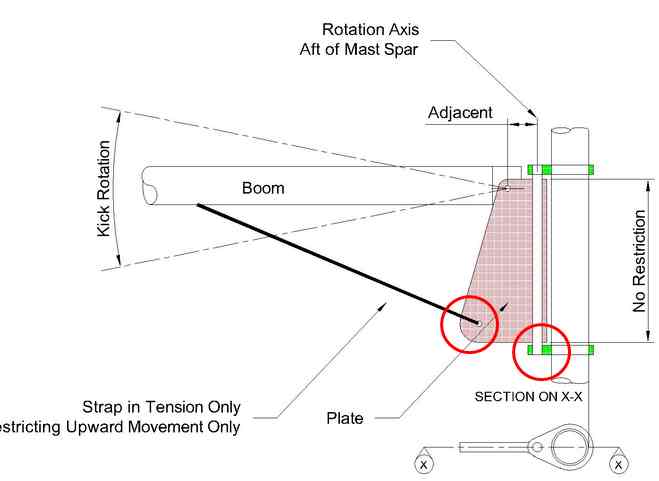
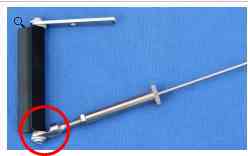
Hi Dave, From your continued discussion, it appears that either you do not understand, or are unwilling to accept the Class Rule interpretation of March 2015. Here are two graphics - a standard fitting, and your diagram. On the standard fitting, the vang attaches directly to the pivot. In your diagram, the vang attaches to the plate and the plate attaches to the pivot. The ruling said that having the extra fitting (the plate) was non-compliant for two reasons - the added area AND the extra fitting which was not included in the rule. John
-
Dave, The rotating plate in your diagram is analogous to the rotating plates in the diagrams A and B in the Technical Ruling. The Technical ruling Q2 refers to the appropriate sections of the class rules. The main rule is F 3.3.a.4 which is singular. F.3.3 FITTINGS (a) MANDATORY (4) Kicking strap fitting. John
-
When James posted his original design concept back in Nov 2014, I suggested that he had a problem. http://www.iomclass.org/phpBB3/viewtopic.php?f=7&t=1839#p11443 Basically he was attaching the vang to a fitting to the mast vang fitting - and that extra part was not covered in our 'closed' rule. So I suggested that he raise it a s a formal question though his NCA (the MYA). This was done and the Technical Committee said the same thing, but they also added the bit about extra function and the projected area. I do not like the added area part of the decision as the part is buried behind the raised fore deck and as has been mentioned above, a rectangular boom adds far more area. I understood the rule change exactly as it was written (per later clarifying diagrams). The 20mm dimension is arbitrary - it could have been (say) 35mm to include all current plate vangs. However there are two 'bottom line' items - first, it is up to a manufacturer to be sure a part is compliant, before putting it up for sale. Second, is that the IOM rule is closed, and every time someone does something 'non- compliant, we seem to do a rule change to make it compliant - so the class rules keep changing. John
-
The reasons are specified in the rule interpretation http://iomclass.org/doc-files/Technical/IOM%20CR%20Interpretations/Interpretation%202015-IOM-1.pdf John
-
Garry, that is not quite correct - the new rule did not make those fittings non-compliant - the rule interpretation in the spring of 2015, did that - it said that all rotating plate style vangs were not compliant with the class rules. What the new rule change did was to make rotating plate fittings compliant, but provided a dimension (20mm) to limit their size. So the new rule provided a route to make those fittings compliant. John
-
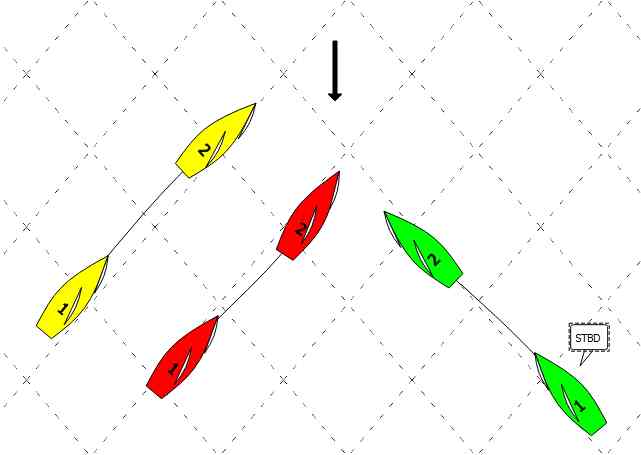
Here is a revised diagram. However it does not change the discussion. Under R 19, Red gets to choose which side of Green to pass. At P1, Red must do something. By P2 it is too late. If Red chooses to tack, she has to hail for room to tack using R 20. But by not hailing for room to tack, she is making an implicit decision to pass astern of Green, and must give room to Yellow to also pass astern of Green. But from your description - she did nothing - she sailed straight on and collided with Green. Green, on stbd is not obliged to do anything, except under R 14 - try to avoid a collision - but Green will be exonerated under R 14 provided there is no damage. Red is still at fault (R10 and R 19.2.b), and Yellow broke no rule. John
-
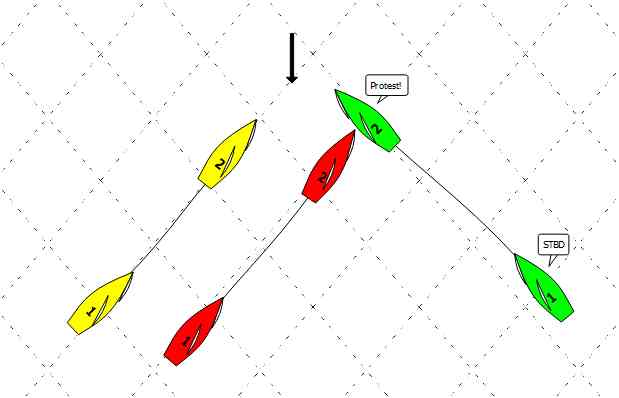
I think this diagram represents your incident. Green is on Stbd and has ROW (R 10) over Yellow and Red. Yellow on port, is windward of and must keep clear of Red, also on port under R 11. As Red and Yellow approach an obstruction, under R 19, it is up to Red, as ROW over Yellow, to decide how to pass Green, the obstruction. If Red decides to tack, she will hail for room to tack under R 20, and Yellow must comply as outlined in R 20. However if Red does not hail for room to tack, her other option under R 19, is to pass astern of Green, and in so doing, must also leave room fro Yellow to pass astern of Green. This is discussed in ISAF Case 11 - When boats are overlapped at an obstruction, including an obstruction that is a right-of-way boat, the outside boat must give the inside boat room to pass between her and the obstruction. In the final summary of Case 11, it says - PW was not required to ‘tack into open water to windward to keep clear’ because PL did not hail under rule 20.1 for room to tack and avoid S. So Yellow did not do anything wrong, and Red is at fault under R10 for hitting Green, and R 19.2.b for failing to provide room for Yellow to pass astern of Green. John
-
I have just added a new article to my Sailing Rules and Tactics series called Proper Course. This one talks about the difference between Right of Way (ROW), Mark Room, and Proper Course. and how they affect each other. The whole series may be found on the Canadian Radio Yachting Association (CRYA) web site http://crya.ca/information/rules-tactics/ And the direct link to the Proper Course article http://crya.ca/wp-content/uploads/2013/06/Proper-Course-jgb4.pdf Hope you find it useful. John
-
Take a look at Yellow in this diagram - she sails much as you described. Now imagine that black line is a piece of string. Pull down on boat number 8 and the string will pull tight, but it will only round the weather Mark, and not the offset - so the course sailed looks just like that sailed by Green. So you did not sail in accordance with R 28 and the protest was the correct action. John

-
I think it would be the distance from the edge of the mark and not from its centre point. Imagine using a large navigation bouy as a mark - if it was from the centre point, then you would have very little water left for mark room. The definition wording also suggests that mark room is from the nearest edge of the mark to the nearest part of the boat. (of course App E makes it four lengths) Zone The area around a mark within a distance of three hull lengths of the boat nearer to it. A boat is in the zone when any part of her hull is in the zone. John
-
There is a simple way to find out if swapping sides will work for you. Hold the radio with the antenna pointing towards you. However, before you do this, go into the programming and reverse direction for Channel 1 and channel 3. Now when you use the radio, the rudder will be your left, side to side, with spring centering, and the sail will be on the right, up is out, down is in, and no centering. John
-
Olivier has answered Q1. These are my thoughts. Q2. May you receive redress for incident A, even if you retire subsequently, having being at fault in incident B. I do not know of any case covering this, but I suspect the answer would be No - retiring after an 'at fault' situation, your finish position is affected by your own action and forfeits any redress. Q3. If you gained significant advantage over another boat, and took a series of penalty turns until the advantage has gone - then you overtake enough boats to avoid relegation, while the other boat fell back and became relegated, the issue ended when you took the penalty. Q4. The observer duties include calling contacts and recording the positions of the boats for the incident, and reporting the incident to the RC at the finish. It would be up to the skipper involved, or the RC to initiate additional action - ie file a protest if they felt that the penalty taken was insufficient. Yes, an Umpire may call additional turns, but not an observer. Q3 raises a different issue. Scenario - you are in B heat with 6 up/down and you foul the boat that is seventh last, such that you finish seventh last and the ROW boat finishes 6th last - so he gets relegated to C fleet for the next race. You did a one penalty turn, but you recovered faster and were still ahead of the other boat after the penalty turn. Did you gain significant advantage? The rule is not clear on what is 'significant'. It is very subjective. On the score sheet for that race, you finish one place higher than the boat you fouled. I would argue that one place in many circumstances, is not significant. If the rule wants you to take penalty turns until you are behind the boat that you fouled, why does the rule not simply say that. (like passing under a Yellow flag in motor racing - get back behind the other guy). However, if the incident happened at the front end of the heat, such that after the penalty, you finish 6th in the heat and get promoted, while the other boat finishes 7th and stays in B - Now you go into A fleet and may finish many places higher in the race that the boat you fouled - that sounds more significant. I really dislike the current wording for significant advantage because of the subjectivity of both the foul (how many boats to be significant) and the penalty (how many turns until the advantage has gone). I have suggested to the IRSA Rules committee to look at changing it in the next RRS so the penalty for significant advantage is to retire. eg. If you foul one boat, do one turn and carry on - if your foul affects more than one boat - retire. John
-
From another forum Janusz Walicki In my search for a TenRater sailboat I e-mailed Walicki Boats (Janusz Walicki). Unfortunately, a very sad response from the wife: "Hello Mr. Perena, Thank you for your interest. I'm sorry I can't help you anymore. My husband Janusz has died last sunday. I can't provide you any boats anymore. Best regards, Beata Walicki" e-mail received 5:47AM June 10, 2015.
-
Hi Gordon, Can we send in an additional clarifying question to the Q&A asking two additional questions about this case. 1. How does Answer 2 relate to RC sailing and E3.7. If the answer to 1 is NO. then Q2 follows 2. When the keep clear boat broke a rule of Part 2 and forced the ROW to break R 30.3, may the Keep clear boat take an R44 (Turns) penalty, or is there significant advantage, such the the penalty is to retire John
-
On re-reading E3.7, it looks to me that its purpose is to relate to the second part of R30.3 and the actions of the Race Committee about displaying the sail number of an offending boat in a subsequent restart of that heat. So I take the view that the Q&A answer does apply to RC sailing. John
-
My point is that E3.7 is not needed - there are already rules that cover a boat not racing. E3.7 seems to be saying that RC sailors are dumber than full size sailors and have to be told to get out of the way. R 30.3 says you are DSQ without a hearing. If you are DSQ you act accordingly. The point of the Q&A answer that there should be recourse for a ROW boat that is pushed over by another boat that is breaking a rule of Part 2. If Appendix E is interfering with that recourse, then the Appendix E item needs to be fixed. John
-
Then I suggest that to allow an RC sailor the protection of the Q&A answer, E3.7 should be deleted and just allow R30.3 to stand as worded. John
-
HI Gordon, I missed it too when I was researching the situation - the title did not help as it did not refer to the black flag start, yet that is what it is all about. If this Q/A will make it into the ISAF Case Book, then there is no need to put it in the IRSA book - in my opinion, the IRSA book should only include items applicable to RC sailing eg based on Appendix E or depth perception or HMS, and not include situations where the application if a rule is identical to big boat s and already included in the ISAF Case Book. Regards John

