


Everything posted by John Ball
-
If Green (Evil 11) on stbd had to alter course to avoid Yellow on port then Yellow has failed to keep clear and breaks R10 P/S. There does not have to be contact. So in a protest hearing, Yellow should lose. The PC could find that there was sufficient room and that Green did not have to alter course, and dismiss the protest. This is a likely outcome if Green did not protest Yellow. If Green chooses to tack to port to avoid Yellow, then Green is not obligated to protest (she 'may' protest). John
-
Hi David, I have tried to diagram your incident. I think your reference to boat B was really boat A. If not, then we need more info about the positioning of B. Yellow is boat A, entitled to mark room,gybes to stbd to round the mark then once past the mark, tacks to port. (Note that Yellow's mark room under R 18.2.b ends as she was given room and had past the mark) Green is the 'dreaded 11'. She gives mark room to Yellow, and follows Yellow around the mark, but on stbd, hardens up close to the mark, and inside Yellow. and is forced to tack to port to avoid Yellow when Yellow tacks in front of her. Basically, this looks like Yellow breaks R 10 by tacking to port while Green is on stbd. Yellow is not entitled to any room to keep clear under R 15 as she tacked to port and caused the change in ROW by her own action. Another possibility but I cannot tell from your description, but if Yellow was futher ahead and had completed her tack to port, and then Green on stbd altered course such that Yellow was not given room to keep clear, then Green would break R 16.1. John

-
Hi Eric, not sure what kind of point you are trying to make here - just being facetious perhaps? The rules are quite clear - and the hail of "hold your course" has no import. The definition of Keep Clear says in part Keep Clear A boat keeps clear of a right-of-way boat (a) if the right-of-way boat can sail her course with no need to take avoiding action and, And RRS 10 says Port shall keep clear of Starboard. So 90 can protest all she wants - but based on that photo, she will lose the protest. John
-
Cannot guess aboout how the protest turned out - insufficient info. Here is a diagram that may not exactly resemble David's scenario, but should be sufficient to discuss the rules involved. For this discussion, David is Blue and having committed a foul needs to take a penalty, but the boats around him prevent him from taking the penalty. R 44 says to take the penalty as soon as possible. While Blue is continuing to sail the course, she is entitled to all the benefits and obligations of the rules. So Blue, on port, has to stay clear of Yellow on stbd. Green to windward has to stay clear of Blue R 11. Red, clear astern has to stay clear of Blue R 12. There is no rule that requires a boat to give to you room to start to take your penalty. There is a rule to stay clear of a boat that is taking a penalty R 24.2. There is a rule to stay clear of other boats while taking a penalty R 22.2. Going down wind, the best way to get clear of this group would be to try to slow down, and Red, astern would have to keep clear. Once clear, Blue can begin to take the penalty either by gybing then luffing to tack, or buy luffing up to tack thenbear away and gybe. If Blue tries to luff towards Green to make room, then as she alters course, she has to give room for Green to keep clear R 16.1 If Blue gybes, she could be starting to take the penalty and must stay clear of Red and Yellow. If Blue fouls another boat while trying to get clear, she has to take a second penalty. If Blue fouls another boat while taking the penalty, she has to start that penalty over again (failed to get clear) and then a second penalty. John

-
absolutely correct. John
-
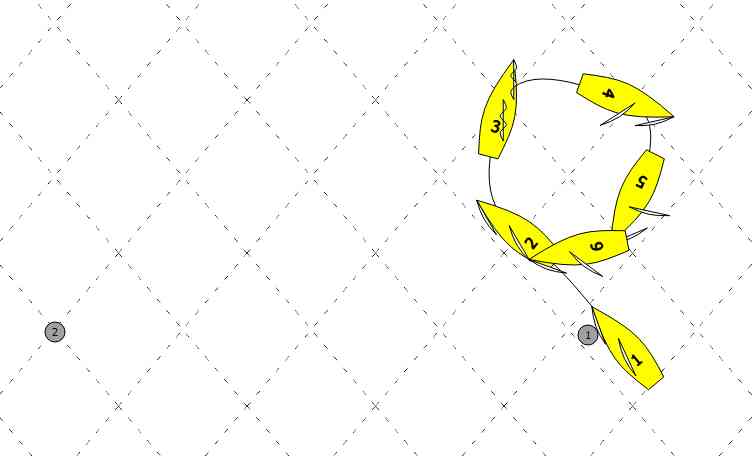
Here is a diagram showing a close hauled boat hitting the weather mark. He luffs up, tacks, gybes and sails towards the offset mark. His penalty turn begins between P2 and P3 as he luffs up to tack and passes HTW. The penalty is complete as soon as he gybes between P4 and P5. John
-
A penalty requires just a tack and a gybe in either order. So yes, a penalty may be completed in much less than 360 degrees. If you want to read more. check out chapter 9 The Penalty Turn on my website https://sites.google.com/site/johnsrcsailingrulesandtactics/ John
-
Not to put too strong a point on it, but what they ask for is rubbish. The preamble to the RRS says that by racing, each of you agree to abide by the rules. All the rules require (E6.3) is to hail in a voice loud enough for them to hear - your sail number Protest their sail number and repeat the hail. It is important not to get into an impromptu protest hearing on the bank - just hail protest correctly and then be silent and continue to concentrate on sailing your boat. Now they have a choice - either take a penalty turn or go the the protest hearing - where they may lose and be DSQ. Debating what happened on the bank just encourages poor behaviour and any loud arguments sets a poor example for other sailors and for members of the public who may be watching. When you file a protest, you are asked to provide the rule under which you are protesting - but it is important to note that you may even quote the wrong rule and it does not matter - the PC will correct the rule applicable during the hearing. If they don't know port from starboard, or windward from leeward, or if they don't know the basics of the four ROW rules, R 10 through R 13, suggest that they look at my web site and read Chapter 1 - The definitions -for beginners Racing 101 some sailing terms explained- and if they want to learn more about how to protest, then Chapter 7 The Protest https://sites.google.com/site/johnsrcsailingrulesandtactics/ John
-
Oops! but that would only be correct if R31.1 is in effect should say but that would only be correct if R30.1 is in effect Sorry John
-
I am not sure what you are trying to get at. As you say, there is no such rule. From what you describe, you are in the 1 minute prestart period, after the prep signal but before the start signal, so you are racing - so the rules apply. You are sailing along on stbd, so the port tack boats must stay clear of you (R 10). That is all there is. Another possibility is that they are trying to say something like - R30.1 ( The I flag -Round the end rule) is in effect and as you reach along the line, if you cross the line inadvertently in the last minute, then you have to go around one of the ends in order to start correctly. They may be saying 'dip starts are not permitted' - but that would only be correct if R31.1 is in effect. Or more seriously, if 30.3 U flag, or 30.4 Black flag is in effect, then you must retire. You are correct that the line is infinitely thin - you are either below the line or part of your hull/rig has crossed the line. John
-
I see the situation this way - Even though you have no rudder control at the moment, (stalled, no wind, etc), you are either still on a tack, or if you passed HTW, are tacking. So the rules that would apply if you were moving normally still apply. if you were 'keep clear' and they have to avoid you, then you broke a rule - so take a penalty once you have recovered. If you were ROW at the time then they have to keep clear of you - so if they hit you, they take the penalty. So no, other boats don't have to give you any special room and time - and your suggested hail has no value under the rules. John
-
The first rule to consider is E2.3 Boat out of Radio Control. If you hail your "sail number - out of control", the you have just retired from the race. You then become an obstruction, and cannot be further penalised for any subsequent incidents. And once retired - there is no 'take back'. What is less clear, is when you hail something like '"Hey! I've got no control" What you are trying to say is "please don't hit me - I cannot get out of your way'. I have chatted with some judges and they seem to agree that E2.3 applies and you have retired, even if you don't have a radio issue because you said essentially that you were out of control. So if you are stuck head to wind- be careful what you hail - best to keep quiet and let the boat go round you and deal with a protest if they call you out - a quick penalty turn is better than retiring. If you nose dive and suddenly decelerate, then you have not altered course - so a following same tack boat has to keep clear - R12. and if you are on stbd, a following port tack boat has to keep clear - R 10. If you are on port and the following boat is on stbd, you have to keep clear, R 10. If you nose dive and broach to one side or the other, you have altered course and may fail to give room to the following boat under either R15 (if ROW changes) or R 16.1 if you remain ROW. In light air, if you have no steerage, then the rules apply based on what tack you are on - and for example if you were on stbd and are now HTW, but not passed HTW then you are still on stbd. So the rules don't care about your boat handling problem. John
-
If the lead boat was clear ahead, then she should be able to tack to stbd without breaking R 13 tacking. While she is tacking, she is subject to R 13 and has to keep clear, and so the other boat briefly becomes ROW. So as you describe it, the following boat that altered course would break R 16.1 ROW alters course. John
-
You may only call Contact if you are sure you saw it. Yes, marks move on the bow or stern wave, so the mark moving is not conclusive. Seeing a mark spin is a better indication of contact, and is a good reason for having stripes on the mark. John
-
Interesting question. What you describe is a windward mark to be rounded to port and two boats fetching the mark from outside the zone. A third boat tacks from port to stbd inside the zone, causing the leading boat above close hauled. There was no contact. The stbd boat did not protest. so what rules may apply? The port tack boat broke R 18.3. So either of stbd boats may protest Port, under RRS 60.1(a) as one was involved and the other witnessed the incident. Soapbox mode ON It shows the importance of protesting by the boat involved as her lack of action affects not just her own position in the race, but other boats too. When you break a rule, you don't 'owe' the penalty to the boat infringed, but to the whole fleet. Soapbox mode OFF John
-
Basically, yes. The RO is allowed to make some decisions, eg calling a boat over early, and deciding who crossed the finish first on close situations, but that cannot make decisions about right and wrong - only a Protest Committee may do that. John
-
This is an interesting question. Appendix E6.3 changes RRS61.1(a) so the hail is 'at the first reasonable opportunity. So the question becomes what is first reasonable opportunity? The replaced RRS61.1(a) says before finishing or as soon as possible after finishing. To me, even though she has missed a mark or rounded the wrong way, it is not clear that the boat is breaking R 28 until she finishes, as up to that point, she could go back and correct her error. So I could argue that the first reasonable opportunity is when she finishes, as that confirms that she broke R 28, However, RRS61 provides that you are not providing outside help when you hail Protest if you hail before she finishes. Would I hail at the time of the incident or at the finish? Probably as soon as it iwas obvious, and especially if the skipper is a rookie. John
-
An Observer does NOT call premature starters - that is the job of the Race Officer. One of the boats in a contact should protest the other. Any boat in the heat witnessing a boat hitting a mark, may protest. Any boat in the heat seeing a boat NOT sailing the course correctly (RRS 28 0 the string rule) may protest. You may find my Chapter 4 Hailing and Chapter 9 The Protest useful. https://sites.google.com/site/johnsrcsailingrulesandtactics/ John
-
I understand the OD as Officer of the Day. That term is not normally used in racing, so you may be referring to the Regatta Director RD, or Race Officer RO. We also use Observers. To learn about the duties of an RO, you may want to take Glen Dawson's excellent and free Race Officer online course. https://eliademy.com/catalog/catalog/product/view/sku/dd8e7afcd4 In brief, normally the RO leaves it to the fleet to call protests for contacts, but the RO may (but are not required to) protest if they witness the incident and no one takes any action. The duties of an observer are to call contacts between boat, or boats and marks, and to record the incident and whether or not penalty turns are taken, are marks rounded correctly, and report to the RO at the end of the heat. If there are called contacts and no penalty taken, then the RO may protest the boat(s) based on the observer report. If you think the RO acted improperly and it affected your position in a race, then you may file a request for redress. The Protest Committee is independent of the RO, and if they find improper conduct by the RO, may institute an R69 Hearing. John
-
My comments on the diagram that I posted above are supported by the RYA Case 1975/5 which says in part Before the starting signal, or if P and S are already on a collision course, or if P is sailing to keep clear by passing to windward of S, S may change course at any time in response to a wind shift, unless she is so close to P that S's change of course would not give P room to keep clear. Room is defined as the space P needs in the existing conditions while manoeuvring promptly in a seamanlike way John
-
Thanks Barry and Mike. From other questions that Erick has posted, I think he is struggling with the concept of keeping clear and room to keep clear, rather than the wording of the rules, and this may take more experience to develop. Here is a diagram, and at P1 and P2, it looks to Red, on port, that she may cross safely. When Green on stbd alters course between P2 and P3, there is no way that Red may now avoid Green. At P1 and P2, Red is not required to anticipate that Green may alter course. Red sees that she is crossing safely. John

-
Hi Erick, if you read the Terminology Topic in the Introduction to the RRS, pg 9, you will find the distinction between defined terms and general usage and below the grid, it says - Other words and terms are used in the sense ordinarily understood in nautical or general use. So the when R 16.1 says ' a ROW boat changes course' you may use a common nautical understanding of that expression - and that would be 'deviates from its current heading' or any other similar expression. John
-
in this context, yes. So briefly maintaining a constant compass bearing, or heading, or direction - John
-
I talk about this R 16.1 situation in Chapter 1 The definitions - Racing 101. and see Page 10. https://sites.google.com/site/johnsrcsailingrulesandtactics/ Think of it this way - if Port was passing clear ahead, and at the last moment, stbd altered course (for any reason, such as a lift) such that Port cannot now get out of the way, then stbd breaks R 16.1. John
-
The use of the term 'significant' in E4.3(b) has bothered me since that rule appeared, and I have written pages of notes debating what constitutes 'significant'. In common usage it would suggest a number bigger than one - else why is it there at all. I have had discussions with a number of National and International Judges and their opinion is consistent and matches the description in IRSA Case Book P4. Essentially if after doing the penalty, you are in front of the boat infringed, take another penalty and test again for advantage. They use this standard in Umpired races (see Addendum Q for RC), and in team racing. One Judge wrote ' After the foul, if you are in front, you have an advantage. If you are in front after taking the penalty, the advantage is significant'. I think it would help if the Appendix E review committee (which is now in session), considered removing the word 'significant; from E4.3(b). Or possibly do a complete rewording so say something in simple plain English like - If after the incident, you are in front of the boat(s) that were affected by your breach of a Rule of Part 2 or R 31, then take one or more penalties until you are behind the boat(s) so affected. John

