


Everything posted by John Ball
-
IRSA Case B2 may apply to any incident as it is about when to stop taking penalty turns. The selected incident just provides an example where multiple boats are involved due to the infraction. My article on The Penalty Turn Chapter 9 and see page 2 may help. https://sites.google.com/site/johnsrcsailingrulesandtactics/ The key phrase in E34.3(b) is (b) if the boat gained a significant advantage in the heat or race by her breach despite taking a penalty, Note that it says 'despite taking A penalty' and NOT despite taking THE penalty. So you need to test for the advantage after taking A penalty, and if the advantage still exists, take another penalty and again test for the advantage. Repeat until the advantage no longer exists. It only needs the protest from the infringed boat to start the penalty cycle, and not a protest from each of the boats in the incident. John
-
Close to the mark is subjective. It is to allow for a variety of conditions - in full sized boats sailing around a big government navigation buoy is different from sailing around an inflated mark, and is different for strong winds and big waves, or flat water and light winds. So it may be taken to mean sufficient space to round safely without hitting the mark with any part of the hull, sails or rigging, including room for the boom to gybe if a gybe is required. In RC sailing, the mark may be some distance away and depth perception is involved. So a subjective term is better than a hard number. My opinion is that if the inside keep clear boat with mark room is taking more than one boat length, then they are being greedy. If the outside ROW boat thinks the inside keep-clear boat with mark room is taking too much room, she can protest. That is much safer than causing a contact. If there is a protest with no contact, then the protesting boat may win the protest, or it may be dismissed. But if there is contact, one boat will be disqualified, and it might be the outside ROW boat. John
-
Great questions. What you are asking about is the difference between Proper Course, Mark Room and Right of Way. I suggest that you go to my web site https://sites.google.com/site/johnsrcsailingrulesandtactics/ and read Chapter 8 which covers these topics in detail. Here is an extract Right of Way vs. Mark Room vs. Proper Course Before discussing Proper Course, the first thing to get our heads around is the difference between having Right of Way (ROW), having Mark Room, and sailing your Proper Course. If you have ROW, the other boat must Keep Clear. However, if you are entitled to Mark Room, then even a ROW boat must allow you enough room to round the mark AND with Mark Room, if your Proper Course from your current position would be to sail close to the mark, that room includes room for you to sail close to the mark. John
-
WS has provided an update to the 2017-2020 Case Book, and the link is here http://www.sailing.org/documents/caseandcall/case-book.php John
-
My feeling is that any 2.4gig digital radio with mode 2 will work fine for RC sailing, and especially for IOM where only two functions are permitted. I prefer a radio with a ratchet on Ch3 - Throttle (sail control) as it allows repeat ability from close hauled to just eased by a couple of clicks. As we sail for many more hours per day than you would expect to fly, you may want to put a larger capacity battery in the Tx. I use a 2400ma and it lasts for a couple of days racing. Carry a spare battery and you can go a whole three day event without needing to recharge. John
-
Thanks, That was exactly the info I was seeking. John
-
We have some marks for use in varying depth and deeper water. The mark has a hollow tube through the center (a cut off golf club works). Then we have an anchor line that passes up through the tube to a spool of line on a wooden shaft that plugs into the top of the tube. Drop the anchor line to the bottom, then plug the shaft into the tube - locking the line at the correct depth. To retrieve the mark, pull the spool and wind up the line and plug back into the mark for storage. And you hands don't get wet. John
-
We are considering a dual registration process in Canada and wonder how it works in the UK. I have questions about how you handle dual rated M. When an M is also registered as a 10R does it get a different hull registration number from the 10R sequence? Is that 10R number displayed on the hull per 10R Class rules? If you do not have a PSN, which sail number do you show at a 10R event- the M or the 10R number? Thanks for any insights John
-
Here are the diagrams now attached, thanks to the web master. John

-
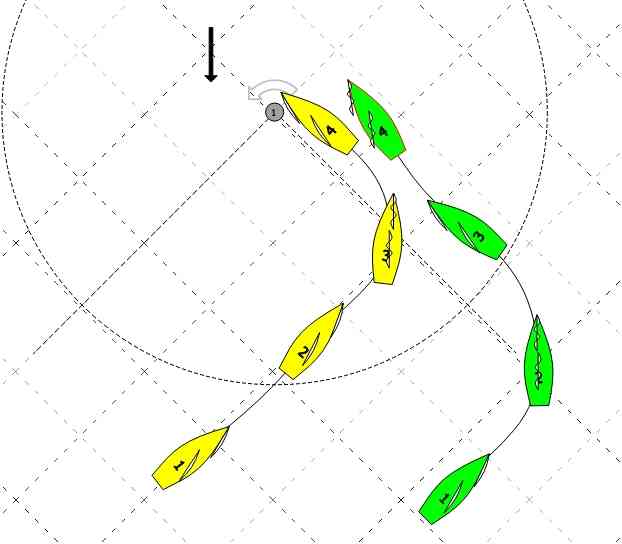
Would RC sailing be better served by moving to a Three length zone? The RRS defines the zone as three boat lengths, and Appendix E modifies that to four lengths. I wrote to the IRSA Rules Committee several years ago, suggesting this change. The answer was that there is no discussion nor support for such a change. So my intent here is to generate some discussion and gauge support for such a change. History. The RRS used to specify a two length zone, and RC sailing adopted a four length zone to allow for more reaction time. Subsequently the RRS changed the zone to three lengths, but Appendix E did not change. Why would we want consider changing Appendix E to use the three length zone? I suggest several reasons. 1. Mark Room rights conferred by R 18 are based on accurately placing the boats positions when the first boat touches the zone. Many skippers have difficulty visualizing the four length zone. It is easy to visualize one length, a little harder to visualize two, harder again to visualize three and so on. The larger the zone, the harder it is to visualize its location. So a smaller zone would assist a more accurate visualization. The counter argument is that a four length zone provides more reaction time that a three length zone. 2. The World Sailing Case Book examples all relate to a three length zone. It is possible with the larger four length zone for issues to develop which may not happen in the smaller zone. If we drop the Appendix E change, and use the three length zone, then all relevant cases would apply. 3. The RRS 2017- 2020 version introduced a change to RRS 18.3 Tacking in the zone. Under the new version, a stbd tack boat has to be fetching the mark from outside the zone for R 18.3 to apply. If R 18.3 applies then the port tack boat that tacks inside the stbd tack boat does not receive Mark Room and may not force the stbd tack boat above close hauled. However when both boats enter the zone on port and tack to stbd, then 18.3 does not apply and when they become overlapped, 18.2.a will apply. This gives Mark Room to the inside boat as soon as she passes head to wind (HTW) and the outside boat must give her that room. With Mark Room comes R21 Exoneration, so even if the inside boat tacks close to the outside boat, she is exonerated for breaking R 13 Tacking. There is a major shift in rights between these two scenarios, and it is all based on when the outside boat achieved stbd tack relative to the location of the zone. I wrote about this change on my Rules discussion web site. Here is an example. We have two boats sailing close hauled on port tack and approaching the stbd tack lay line for a mark to be rounded to port. Yellow is to windward and about two boat lengths below the port lay line. Green is about two boat lengths to leeward of Yellow and sufficiently clear ahead that she can tack to stbd and not break R 13 Tacking. Green tacks on the lay line. Yellow tacks inside Green. Green goes above HTW and there is contact. Yellow touches the mark, and there is contact between the boats. If there were a three length zone, it would be easy to infer that Green entered the zone on stbd and R 18.3 would apply and Yellow would be at fault. However with a four length zone, it is very close as to where Green passed HTW and gained stbd tack – inside or outside the zone. Yet the outcome for this incident and the applicable rule (R 18.3 or 18.2.a) is dependent upon this factor. Here are the two boats – the diagrams are identical, except that the zone is changed from three lengths to four. Remember that there are no circles on the water, and we have to estimate the location of the zone, possibly from a distance of 30 meters or more. John
-
I have some diagrams that cover this type of incident in my article "Chapter 8 Proper Course" on pages 6 and 7. This article covers the situation from the perspective of R 17, but is covers R 15 too. https://sites.google.com/site/johnsrcsailingrulesandtactics/ John
-
Hi Erick, Your first two summaries are fine, but these two need a bit of work. My comments are in bold Boat B need not give room to Boat A and can luff at any time but as she becomes ROW, she has to give room under R 16.1 if she alters course Rule 15 – Not applicable to Boat B Rule 11– Applicable to Boat A Rule 17 does not apply if they became overlapped before A completed her tack. Boat B could have tacked to starboard immediately Boat A looked like tacking? As A luffs up to head to wind, she is still on stbd, and not yet subject to R 13, so B must still stay clear under R 10. Hope this helps, John
-
Hi Barry, that phrase is part of the whole sentence - all it says it that in that circumstance, she does not have to "initially give room" when she gains ROW. JOhn
-
Hi Barry, That’s a really good question. The quick answer is “no” – When the ROW changes but is caused by the boat that previously had ROW, the new ROW does not have the responsibility to give room - she may continue on her course. But it does not give her a hunting license, eg – she cannot luff sharply, as 16.1 would apply. R 15 is a ‘momentary’ rule that applies briefly when ROW changes. If you gain ROW by your action, then R 15 says you must do it in such a way that the other boat may keep clear – and they have an obligation to begin to keep clear. If they touch you as they try to keep clear, then you did not give enough room, and break R 15. If they delay and subsequently the boats drift together, then they break the applicable room, eg R 11 W/L. The R 15 protection has that word ‘initially’. The opposite situation is where the stbd ROW boat tacks to port and to weather of a Port tack, now an overlapped leeward boat. PL does not have to give room under R 15, and if they are so close that new W cannot stay clear, then the boat that tacked probably broke R 13 and also breaks R 11. But once the overlap exists, L may only alter course (eg luff) if she gives room to W to stay clear under R 16.1. There are no cases that cover this explicitly, but the preamble of several cases (below) provide some guidance. John W.S. Case Book. CASE 27 A boat is not required to anticipate that another boat will break a rule. When a boat acquires right of way as a result of her own actions, the other boat is entitled to room to keep clear. CASE 93 If a boat luffs immediately after she becomes overlapped to leeward of another boat and there is no seamanlike action that would enable the other boat to keep clear, the boat that luffed breaks rules 15 and 16.1. The other boat breaks rule 11, but is exonerated. IRSA Case Book Case B8 A boat that deliberately gives up right-of-way and immediately sails into a position in which she can only avoid contact with one boat by breaking a rule and making contact with another boat resulting in damage is sailing without concern for the consequences of her actions. She does not comply with the basic principle of sportsmanship and the rules.
-
Hi Terry, I agree with your first comment. The stbd boat that tacks and causes P to make a further alteration of course breaks R 16.2 and maybe R 13 or R 11. Once S has tacked to port and becomes windward and ROW changes to the old P, R 15 does not apply as the change in ROW was caused by S when she tacked. In second question, R 16.1 would apply, and S has to give room to P to stay clear as S alters course to take the lift. So while S may always protest, in this case, I think the protest may be dismissed. John
-
Sorry Charles, I misspoke when I said there is no 'Shall'. There is a shall, but it is qualified by 'make as fair an arrangement as possible'. What is possible may be limited by property ownership, funding, and other resources. In the UK, you are blessed with several good purpose built yachting ponds, like Fleetwood. I know of only one in the USA, at San Diego, and non in Canada. There as several sites where we have a sidewalk, promenade or long dock, but that is rare. We use park ponds and lakes, frequently surrounded by grass, and bushes. Frequently we sail on sites requiring wet launch. We have to make the best arrangements we can, and that may be very limited. But better to sail with compromise than not sail at all. Our wheelchair sailor takes it all in good spirit and is quick to remind us if we walk in front of him. But we will quickly help if he needs his boat retrieved, or launched or adjusted, and there are lots of willing bodies to give a push up a ramp. John
-
Hi Charles, I cannot find any reference in the RRS that 'mandates' accomodation for disabled. E3.9 applies to the Race Committee and not to a host club. Can the Race committee provide a ramp to the pond to bypass steps? Can an RC lay a smooth path along the pond for wheelchairs?- probably not, as the RC does not own the property and does not have funds. A club may face similar limitations. So there may be real physical reasons for a club to be unable to make 'easy' access. The intent of E.9 is to encourage a level playing field - but it is not mandatory - ie there is no 'shall'. World Sailing provides for disabled sailing through the Special Olympics and similar events, but I cannot find a general policy statement that would relate to Radio Sailing. US Sailing has a prescription that places a statement into the Intro of the RRS Equal Opportunity As the national authority for the sport of sailing, US Sailing is committed to providing an equal opportunity to all sailors to participate in the sport of sailing. I cannot tell if the RYA has anything as the RYA prescriptions are not easily available online, they are combined with the RYA RRS publication and they want money for it. So to me accommodation includes things like restricting the control area to a wheelchair accessible section, asking skippers not to walk in from of wheelchair competitors, using tape to keep competitors behind any wheelchair sailors. We have a wheelchair competitor in our local racing and these steps have worked for us. John
-
I finished watching the video - quite good and no surprises. Remember that this is for 'big' boats so not Appendix E - hence the three length zone, and two turn penalties comments. John
-
Just found this on Youtube. Have not finished watching it all yet, but it looks good, although a but long at about 90 minutes. John
-
The new 2017 – 2020 edition of the World Sailing Case book is now available for download. http://www.sailing.org/documents/caseandcall/case-book.php There are a number of new cases in the this edition, starting with Case 132 . They all make interesting reading especially for anyone who may be part of a Protest Committee. Here I will touch on just three of them. Case 138 helps the Protest Committee determine when to apply Rule 2 or Rule 69. CASE 138 Rule 2, Fair Sailing Rule 69, Misconduct Generally, an action by a competitor that directly affects the fairness of the competition or failing to take an appropriate penalty when the competitor is aware of breaking a rule, should be considered under rule 2. Any action, including a serious breach of rule 2 or any other rule, that the committee considers may be an act of misconduct should be considered under rule 69. Rule 69 is always a serious matter. For this edition of the RRS, there is a change in Rule 69 that now allows for a variety of punishments, and Case 139 provides assistance. CASE 139 Rule 69.2(j), Misconduct: Action by a Protest Committee Examples illustrating when it would be ‘appropriate’ under rule 69.2(j)(3) to report a rule 69 incident to a national authority or World Sailing. Case 140 is very interesting as it covers the options when a boat is forced over early by another boat that is breaking a Rule of Part 2 – (eg a stbd tack boat goes over the line avoiding a Port tack boat) when Rule 30.3 U Flag, or R 30.4 Black Flag is in effect. It describes how the fouled boat may behave in order to obtain redress. This case makes a strong argument for the Race Committee to select the use of the U flag option over the Black Flag option. This one is a 'Must Read'. CASE 140 Rule 30.3, Starting Penalties: U Flag Rule Rule 30.4, Starting Penalties: Black Flag Rule Rule 62.1, Redress Rule 64.1(b), Decisions: Penalties and Exoneration How the rules apply when a boat is compelled to cross the starting line by another boat that was breaking a rule of Part 2. John
-
The new 2017-2020 version of the World Sailing (ISAF) Case book is out. http://www.sailing.org/documents/caseandcall/case-book.php John
-
I have added a new chapter - Chapter 9 The Penalty Turn on my rules and tactics web site. https://sites.google.com/site/johnsrcsailingrulesandtactics/ and look for chapter 9. This article discusses when and how to take a penalty correctly and includes a Techniques section by world famous builder and former IOM World Champion Craig Smith to help with your boat handling skills.. John
-
HI all, I have updated all my Racing Rules and Tactics articles to match the changes in the new 2017 -2020 Edition of the RRS. They have a new home too, on google sites. Here is the link https://sites.google.com/site/johnsrcsailingrulesandtactics/ If you have read them before, then I suggest that you revisit Chapter 3 R18 and the Weather Mark . It was the most affected by the new RRS and has the most changes. I hope you find them useful. Please post any questions or comments on this forum so we can all participate in the discussions. John
-
Easton aluminum arrow shafts come with a code eg XX75. The two digits are the alloy - and for an IOM look for the 75. they make others that are not on the approved list. Then they have a four digit code eg 2514 the first two digits is the diameter in 64th of an inch. the larger diameters, like 24, 25 26 are stiffer than the lower numbers. The second two digits are the wall thickness in thou. I have used Camo XX75 2514 and XX75 2613 The easton web site lists this but the larger diameters are missing. Biggest dia is now 2413 https://eastonarchery.com/target/camo-hunter/ John
-
The ROW rules (R10,11,12,13) apply all the time. R 18 may modify or restrict the ROW boat to give mark room. So if W has mark room at the finish line, then L has to give that room, even though R 11 applies between them. John

