John Ball
Forum Member
-
Joined
-
Last visited
Everything posted by John Ball
-
Just took a quick look through the new Case Book. One important clarification is in Case 113 about hailing for room to tack at an obstruction and R 20. The clarification (using Appendix E) is that any hail that does not include [hailing boat sail number] Room to tack is not a valid hail and may be ignored by the other boats - so make sure that you hail exactly as specified - and get used to doing it! This addition codifies the results of several appeals into the Case Book. John
-
Finally- it's out. Here is the link, and scroll down to the Case Book. https://www.sailing.org/racingrules/ I have not yet read it. John
-
I think that by sheeting in the main and letting out the jib, Ian is saying to open the slot a little. From memory, Ian does not increase the draft of the foot of the main, but may increase the draft of the jib a little. I suggest other changes for light air. Ease the back stay so the mast comes up straight to put some draft into the main. This also reduces the tension on the forestay, which puts some roundness in the leading edge of the jib. Ease the luff tension on jib and main. Ease the mast ram and vang to allow a bit more twist in the main as the wind gradient effect is more pronounced in light airs. If you sail with tight shrouds, ease them off a bit as this also affects jib stay tension. How you sail is important - sail the boat with the sails cracked off to build and maintain boat speed – this will increase apparent wind, and reduce leeway. Avoid trying too point high. John
-
Hi Roger, As R 17 apples, Green is obligated to not sail above her proper course. Proper course is subjective, but bearing away to a downwind course of some type is reasonable. Holding on to the reach or going higher does not seem reasonable. As Leeward boat, Green's proper course is what counts - but it must be defensible in a protest hearing. John
-
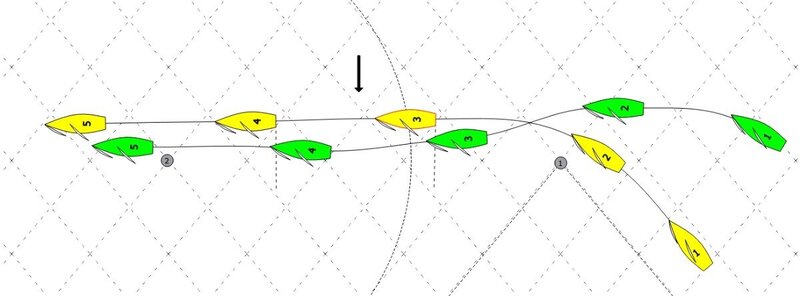
Hi Roger and Colin, I have created a diagram that I think represents your question. As drawn, Green obtains an overlap from astern and this meets the description for R 17 to apply. So yes, Green must bear away to her proper course to the next mark which is dead down wind as soon as she has passed the offset mark. Green established an overlap before Yellow touched the zone, and is entitled to mark room, which was given. John
-
Hi Roger, I cannot give you an answer about R 17 as the important information is missing. R 17 only applies if the other boat established an overlap to leeward from astern and within 2 boat lengths. So how you became overlapped is crucial to your scenario. If it applies, then YES, the leeward boat should begin to sail their proper course to the next mark after clearing the offset mark. However if R 17 does not apply, then there is no rule in effect which requires proper course, and so the leeward boat may luff you, subject to R 16.1 and you are required to keep clear under R 11. The proper course mention in R 18 ends once mark room has been given, and you as the outside boat was required to allow the inside boat with mark room to sail her proper course to the mark. I discuss R 17 with some examples in Chapter 4 - Hailing and other rules around the course, and from see pg 11. https://sites.google.com/site/johnsrcsailingrulesandtactics/ John
-
Many IOM, M, 10R and A class boats use an RMG smart winch. It has a number of adjustable settings - one is a low battery alarm. If it is set for LiPo, and you put in a LiFe, it will quickly trigger the alarm and go to fail safe, as LiFe are about 1 v lower that LiPo. John
-
If you switch to LiFe, remember to reset the low battery warning setting on your RMG. John
-
Thank you all for your feedback. I have updated my article to include it. Here is v2. John Wind - the invisible engine v2.pdf
-
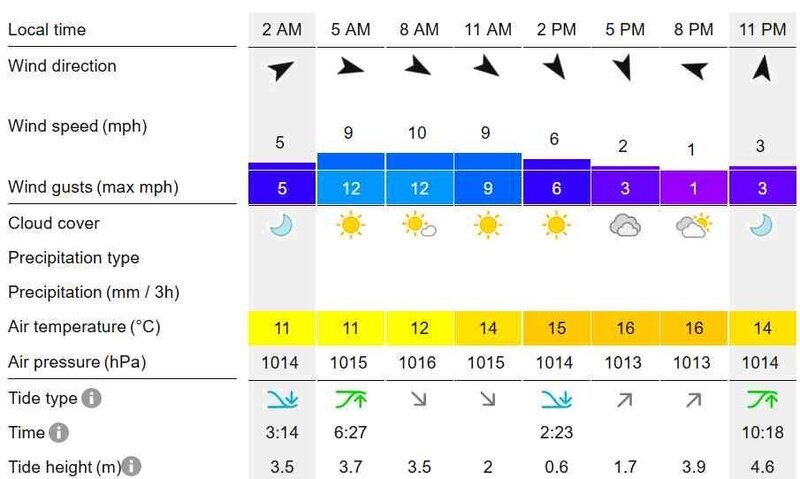
Hi Larry, thanks for the feedback. Yes, I agree on your observations about forecast models. I just use them as a simple guide. Is there going to be wind? From which general direction (our local site is fine except for due north and due south), and the temperature, and if rain is forecast. The screen shot below shows me to expect a good sailing day with steady winds during our race window and an acceptable direction, comfortable temp and no rain! A persistent shift is indicated late in the day, long after we have quit. Using the forecast tool over time builds experience and confidence in its accuracy for our local water. I still use my eyes and experience reading the water and gusts to select my rig. John
-
While I usually write articles on the rules and tactics of radio sailing - this one is quite different. The wind that powers our boats is invisible. What is Wind? What causes it? How does it affect how we trim our sails? I discuss these and related topics in a new article "Wind - the invisible engine" which may be found on my web site. https://sites.google.com/site/johnsrcsailingrulesandtactics/ and scroll to the bottom of the home page where I have some short items in the Appendix. It's is also attached below. I hope it helps you understand what wind is! Enjoy! John Wind - the invisible engine.pdf
-
The 290EF would be my choice for an IOM - the F stands for fast - less turns available than the ES (second choice). The 3 series is for bigger boats like M, 10R and A. John
-
It is safe to say that if a boat believes that is has broken a rule of Part 2 or 31 it may take an applicable penalty. If they have taken an applicable penalty, they may not be penalized further unless the penalty was DSQ. It is not worded as an admission of guilt nor fault. I think the concept of fault applies more to to damage and insurance. I have heard that Insurance companies have been known to accept the findings of fact of a PC as a neutral and qualified party. Redress may be awarded if a boat's position was affected by another boat's breach of a rule and involves a list of qualifying factors. Usually redress if awarded would be average points. John
-
Hi Colin, I think the answer is contained in the wording of 60.5. 60.5 However, the boat shall not be disqualified if (c)(2) the boat has already taken an applicable penalty, in which case she shall not be penalized further unless the penalty for a rule she broke is disqualification that is not excludable, John
-
Not commenting on a protest decision is normal practice. We don't have the facts and may only hear one side of the arguments as to what happened. What I try to do is describe which rules may be applicable. The benefit of a protest hearing is the learning opportunity for the participants. If there are misgivings about a decision of the PC, the appeals process adds to that learning process for the future for the parties and for the PC members. Without commenting on the decision, superficially, there seem to be grounds for Ned, the DSQ boat to appeal on grounds that the PC erred in assigning an additional penalty, and the lack of grounds for redress and the specifics of the redress decision. John
-
It is not appropriate to comment on the findings of a Protest COmmittee - and the parties are free to file an appeal on the decision of the PC. In general, once a boat has taken an appropriate penalty, they may not be punished further. For a simple contact, a one penalty turn sounds appropriate, as it is not clear that any advantage was gained. If there was an advantage, and the penalty was inadequate, then the PC may apply an additional penalty. Redress is a separate issue altogether. To be awarded redress, there are a list of conditions that must be satisfied to be eligible for redress. Are any of them present in this incident? (rhetorical). John
-
I have used this method of bending the shrouds to hook directly into the mast. https://www.facebook.com/iomsdownunder/videos/another-tip-to-make-building-a-rig-just-a-little-easier-thanks-to-graeme-howie-f/1492045977491350/ It is simple and works. John
-
Thanks to Gordon for bringing this to our attention. This is an important interpretation from World Sailing on how to hail for room to tack at an obstruction - and what happens if the hail does not comply with the wording in R 20. I have added an article to my web site https://sites.google.com/site/johnsrcsailingrulesandtactics/ See the Chapter 4 Bonus item - R20 and hailing for room to tack - an update. The bottom line is that if you do not say EXACTLY [my sail number] Room to tack ( example zero seven Room to tack) then your hail is not valid under R 20 and is treated as if it did not exist - so there are important implications on which rules apply. John
-
If you have an RMG winch, check your manual for Deadband John Input Deadband Input deadband is the amount dithering in the Rx signal that a servo can tolerate without responding to by constantly jittering. This is adjustable from 0.8 to 10 microseconds. Deadband adjustment allows the optimisation of TX fine trim control. The default setting is 5 microseconds.
-
I am no expert in radio technology, but here are some possibilities. 1. Do a range check using the instructions for your radio. If the range is poor, there could be a problem with it. 2. Do you point the antenna straight out, pointed towards the boat? Turn the antenna so it is straight up, or set to the side. The radio signal looks like a couple of balloons that emit out from the side of the antenna – and the low spot is straight out the end. 3. Check that the Rx antenna is taped up under the deck as high as possible – away from the fin and battery and leads. If twin antenna, set at 90 degrees to each other. John
-
Hi Dave, I cover this situation and variations in Chapter 2 The Start - and see pages 10 and 11. The rules have not changed for this situation. https://sites.google.com/site/johnsrcsailingrulesandtactics/ John
-
The IRSA and the Appendix E Working Group completed the review and update of the Radio Sailing Call Book in late 2024 and at least WS have finally published it - the WS Case Book is still not out. One problem is that the rewrite of R 18.2 which changed the order of the rules and renumbered them without any real change of meaning has created a lot of detailed updates to many of the cases. The 18.3 change to turn off 18.2 when 18.3 applies only affected a few calls and cases - but was significant as that change reversed some of the decisions as the boat that tacked in the zone no longer gained mark room. John
-
Hi Colin, Just as in real life, when a crime is committed, the guilty is entitled to due process, but the victim has no rights, So when a ROW boat(s) is stalled, the keep clear, fouling boat has to take a prescribed penalty, but the victim has no special rights except if disabled, when redress might be available. But even then, while they might receive redress points, they would still be relegated and have to fight their way back. John
-
If you watch SailGP you may be fooled on how to apply the rules - but they have a modified set of rules. If you foul a boat in SailGP, your penalty is to get behind them. They have another interesting rule - we are used to calling for room to tack at an obstruction on a beat, and they have a similar rule for their boundary but as they sail such high angles downwind and they seem to tack where we would gybe - so they also have a room entitlement for downind. Special event - special rules. John
-
I suggest to read the WS Call Book for Radio Sailing, especially Call B2. The call book may be found by visiting my web site https://sites.google.com/site/johnsrcsailingrulesandtactics/ and click on the Racing Rules Reference tab at top of the page. Also read my Chapter 9 The Penalty Turn. The bottom line is that an advantage is when you gain places in the heat. So if you are in (say) 3rd place on port and foul two stbd tackers, and if you had gone behind you would have been in 5th place, and the two stbd boats are stalled out - then you should take one or more turns until two boat have passed you so you are in 5th - not until behind the two boats you fouled. John