


Gordon W Davies
Forum Member
-
Joined
-
Last visited
Everything posted by Gordon W Davies
-
Case 138 gives examples of acts of misconduct including: acting recklessly or in a manner that does, or is likely to, cause damage or injury. The same case states: Generally, an action by a competitor that directly affects the fairness of the competition should be considered under rule 2. Any 'pile up' or entanglement, is likely to cause damage or injury. So sailing recklessly, causing a pile up, could be considered as a breach of RRS 2 (penalty DNE. Repetition of the infringment could be the object of a report under RRS 69, penalties could lead to exclusion from the event.
-
I based my distances based on measurements taken from the control area, provided by a member of the jury and by a member of the race committee. The fact remains that in many heats umpires, observers and competitors could not read the sail numbers at the furthest mark. The result is an increase in incidents and a decrease in decisions.
-
Are our issues course distance related, venue related, skipper behaviour related or umpire standard related? A short answer: Yes, the issues are course distance related, venue related, skipper behaviour related AND umpire standard related! In an ideal world: An ideal venue would allow marks to be set at no more than 60m to the shore, yet allow for a decent windward leg, in all common wind directions. Setting a course with the wind coming off the shore, with trees or building obstructing the wind flow, will never be a good idea. I would argue that, in reality, the number of venues suitable for a World or Continental Championship is very small. Competitors would sail conservatively to avoid risky manouevres, and take a penalty when they may have broken a rule. There are still some sailors (even in a Worlds A heat who NEVER take a voluntary penalty but wait for an umpire decision. Major radio sailing nations would insist on national and some regional events being umpired, so that there was a far large reservoir of experienced umpires available for Worlds and Continentals. For my part: I recognise that my umpiring is completely different when I am following the part of the fleet near the shore. I can follow most incidents among the 6 or 7 boats I am following. When I am following the boats outside: I cannot read sail numbers of boats beyond the outside start mark, of the boats that tack away from the shore, nor the boats on the layline coming in to the windward mark. This also means that I, and most sailors, cannot judge laylines nor rapidly analyse relative speed, angle and distance between these boats. This means, for instance, that,if I cannot accurately judge the distance between two overlapped (and incognito) boats, how can I decide if the outside boat has not given enough mark-room to round the mark without touching it. During the Worlds , the RC made a real effort to keep the windward mark within about 75m of the shore. This meant that I, my colleagues and nearly all the observers we worked with could read the sail numbers when boats were approaching the offset mark! Windward gates provide a partial solution, in that there are (usually) fewer boats rounding each mark. Outside-in gates create a further zone with a high potential for incidents a few boat lengths down wind from the gate. We may have to change our umpiring strategy by placing an umpire to observe this area, which may mean that there will be only one umpire for both leeward marks!
-
When using the inside out gate with offsets on each side we observed that most boats made a starboard tack approach. The result: two lines of boats each on the layline to the mark. The boats on the leeward layline could bail-out by tacking, those on the windward layline by bearing away. They would then round the opposite mark, passing a short distance to windward of the mark, avoiding any congestion.
-
Thank you Derek for pointing us in the direction of one key point in the discussion. He refers to the issue of identifying boats. Many of the issues encountered at the windward mark disappear or are significantly reduced if all sailors and race officials can see what is happening! If all participants can easily read sail numbers this means that they can also better judge: Laylines The distance between overlapped boats Whether boats are on a collision course When the marks are set too far away, umpires and observers spend a great deal of time just trying to read sail numbers, in case there is an incident. This is especially the case for the umpire watching the far end of the start line. At Datchet there was hardly a start at which umpire and observer could read the sail numbers of boats beyond the outside start mark. There are particular issues at the windward mark when it is set more than about 65-70m from the control area and the fleet is sailing from right to left. Boats on port are sailing away from the shore and the sail number is invisible. The boats approaching on starboard cannot judge accurately if they are on the lay line, above it or below it. So we have, for the observer or umpire, two orn more unidentified boats heading towards the area around the mark (NB, in certain lights at Datchet even hull colours were difficult to see). The worst pile ups at the windward mark in these conditions are frequently caused by the starboard tacker, realising, when they have already entered the zone, that they are below the layline. If they are only slightly below, they may attempt to luff, causing boats outside and astern to also luff and slow, even stall. Otherwise the boat (still unidentifiable from the control area) will tack and aim for a gap that may or may not exist. If the gap does not exist, chaos is almost guaranteed. Even if the observers and umpires can follow the (unidentified) boat until the sail number is legible (often just before or after the offset mark) the damage has been done. The race has been ruined for several boats. There is also an issue with umpiring culture. Umpires will not penalised a boat unless they are certain that the boat has broken a rule.They will need to be even more certain before giving a penalty under RRS 2, Fair Sailing. The obvious solution is to lay marks closer to the control area. This creates other issues, as race officers wish to set a balanced windward leg. When the course is close to the shore, both sailors and race officials can see what is happening. The number of incidents is greatly reduced, and the percentage of incidents resulting in an umpire decision increases. So, when choosing a venue for a major event, a key criteria should be 'can the race committee set courses in all (or at least the most frequent) wind directions with marks less than 65-70m from the shore?' I have come to believe that there are very few venues that can met that criteria. I have been to a few venues that did meet that criteria - Fleetwood (the lake is only 62m wide), Limone (on Lake Garda), Nynasham I hope I spelt that right,) (Sweden , DF65 Globals), Ste Hilaire (only on the far shore, but the distances to walk were enormous) to mention a few. One issue in Datchet, as an umpire I was making a concious effort to walk up as far as possible to get close to the windward mark, to get as near as possile to the leeward gate and to get to the finish line. At most events I would be close to at least the better sailors in the heat. This was far less the case during the Worlds. In particular, many sailors were standing well to leeward of the finish line. I remember one leeward gatemark rounding where there were only 1 or 2 sailors with 50m of me. I think I hailed 4 mark contacts and note 2 marks not rounded. I am fairly sure that the competitors, from where they were standing, did not see the mark contact.
-
Is there anyone on this forum who atended bothe the M/1OR Worlds last year and the IOM Worlds this year? If so I would be very interested to read their opinion on the windward gates used: M/10R: inside out gate with offset marks on both sides of the gate IOM: outside in gate In particular I wish to know if, in your opinion, different gates: reduce the number of incidents at the windward mark; distribute or concentrate the fleet at the start of the run; allow boats to bail out if they mis-mis-judge the lay line, or which to avoid a congested mark facilitate the work of the observers and umpires; facilitate the setting of fair courses. As a judge/umpire a both events I have a personal opinion which I wil reveal if this thread has some replies. I may well be that my opinion will be very different ffrom that of competing sailors.
-
The IRSA Race Management Policies state: General Recall 8.1In case of any problems with the starting line (such as length, or angle to the wind,etc.) a postponement may be signalled, even up to the last second before the start, instead of a general recall. 8.2 If a race management error is discovered after the starting signal (e.g. timing), the course management team may abandon the race. In these circumstances, the course management team will not signal a general recall. 8.3 When the course management team is not satisfied that all boats over early (or that have broken rules 30.1, 30.3 or 30.4) have been identified, a general recall will be signalled. 8.4 In the event the start has been postponed, or a general recall has been caused by the length or angle of the starting line, the course management team will adjust the starting line and make another attempt using the same preparatory signal. 8.5 If the course management team is satisfied that a general recall was not the result of the length or angle of the starting line or a course management team action, it will signal the use of a rule 30 starting penalty (I flag, U flag or black flag) for each subsequent attempt to start the heat 8.6 An important principle to be followed by the course management team is that rule 30 starting penalties will only be used when general recalls are caused by the boats themselves, or rapid oscillations of the wind, and not by actions of the course management team. 8.7 When using the black flag, the course management team will make every effort to signal a postponement in the event of any problems with the starting line. These policies closely mirror those of WS.
-
This is the fundamental flaw of the outside in windward gate. At the M/10R Worlds last year the RC set an inside out gate with offset marks on each side of the gate. Once the sailors had worked out how this worked there was a significant reduction on incidents at the mark. Few boats attempted an approach on the port layline. Instead boats approached on the starboard layline of both marks. Boats that came up the left hand side of the course would sail to the left hand mark layline. Boats on starboard would form two queues along the layline. One advantage is that if there was an issue ahead it was always possible to bail out at the last moment by heading for the other mark (either by tacking or bearing away). This is an advantage when the marks have to be set some distance from the shore. As boats arriving to the right-hand mark had to tack to round the mark, the RC set the offset leg on that side slightly shorter
-
Darin, Redress in this case - becoming disabled because of the action of a boat breaking a rule of Part 2 - can only be given if : - the boat requesting redress's score has been made significantly worse - through no fault of her own (however minor the fault) - for instance could she have avoided the contact - if the boat breaking a rule of Part 2 has been penalised or took a penalty. See RRS E6.6 NB: there is no minimum time for being entangled - just long enough for a boat's score to be made significantly worse. In some case's this may be only a few seconds.
-
One reason why judges have a long training process is to ensure consistency in applying the rules. From memory (I was not on the panel that decided this case): in this case two boats were entangled for a very short period. They were therefore disabled. The jury found that neither boat's place was made significantly worse while the boats were entangled. Once the boats were separated and able to continue in the race one boat, I presume yours, was in irons. As the boat was able to continue in the race no redress could be given. There is no redress for a boat (of whatever size) that is in irons following an incident, or, in the case of a dinghy, capsizes.
-
The key question is, how long does an entanglement have to last. - long enough to make a boat's score significantly worse.
-
The 'unable to continue on the race' has been consistently interpreted, as being in a situation in which the person controlling a boat cannot perform a seamanlike action to enable the boat to progress in the race. This includes being entangled with another boat, with vegetation in the water or on the bank, running aground, or damaged. Only by luck, or by the intervention of the a safety vessel, can the boats may become 'un-disabled', and then return to the race. On the other hand, the persons controlling boats that are rafted together, but not entangled, or a boat that is in irons, can perform seamanlike actions with the rudder and sheet that can enable the boat to return to the race. When discussing redress following an incident in which a boat is disabled the jury will ask: - was the boat disabled -did she become disabled because to the action of another boat that was breaking a rule of Part 2. Did the other boat take a penalty and or was penalised. - was the boat's place in the heat or race made significantly worse while she was disabled. How many place's did the boat lose while she was disabled. - was the boat at fault in any way. For instance, if the boat could have avoided the contact and thus becoming disabled then she will not get redress. A relatively common occurence is when two boats become entangled, then break free but one boat (who may have grounds for redress) then gets stcuk in irons. Any redress given will be for places lost from the time the boat became entangled until she broke free.
-
There is a team racing call C2 which illustrates the rules that apply; TR Call C2 Gordon Call C2.pdf
-
World Sailing has issued a Q and A concerning the new obligatory hail for room to tack: in radio sailing ‘[my sail number] Room to Tack’ When the hail does not conform to the required wording there were two options: the hail was considered to break RRS 20.1 and the hailed boat was required to respond by tacking or hailing ‘You Tack’. The hailed boat could protest the hailing boat for the incorrect hail; or the incorrect hail was considered not to be a request for room to tack. The hailed boat is not required to respond. Rule 20.2 does not apply and the rules of Section A and B do. The Q and A panel has chosen the second option. A hail for room to tack that does not include ‘[my sail number] Room to Tack’ is not a correct hail therefore RRS 20.2 does not apply. This may lead to situations in which a hailing boat believes that they are entitled to room to tack, and the hailed boat believes that they do not have to respond. It also means that different rules will apply depending on whether the boats are initially on port or on starboard. Our experience at the M/10R Worlds were that some sailors learnt to use the obligatory hail quite easily. Others did not. The umpires explained several times the reasoning behind the hail of ‘my sail number. This serves to identify the boat that requires room to tack. There may be several boats that need to respond, and it is unlikely that the hailing boat can identify them all. The umpires reminded sailors who made an incorrect hail that they should make the correct hail. We shall see how this works out. I look forward to your reactions (please try and remain with the limits of forum decorum!) 2025 7 room to tack.pdf
-
There is a WS Q&A, recently published, that addresses the issue of 'advantage'. This upholds the principles set out in the Radio Sailing Calls. Previously David wrote: IOMs are particularly long and narrow, more like a canal boat than a racing dinghy. Just being close to another boat creates a handicap even if there is no contact. Two boats can become temporarily 'disabled' without any infringement. Two boats that are close to each other, or even touching each other, are able to manouevre and continue racing.They are not disabled. Neither is boat that is in irons. In both cases there are acts of seamanship that allow the person controlling the boat to manoeuvre the boat. A boat is disabled while it is unable to continue in the race: this may be because it is entangled with another boat, or vegetation, aground... In these cases there is nothing the person controlling the boat can do. 2025 2 advantage.pdf
-
This happens quite often in dinghy and keelboats There is usually a chain of protests, often initiated by the PC as they learn the facts. It seems to me that now the windward boat who hit the mark could protest the furthest leeward mark.
-
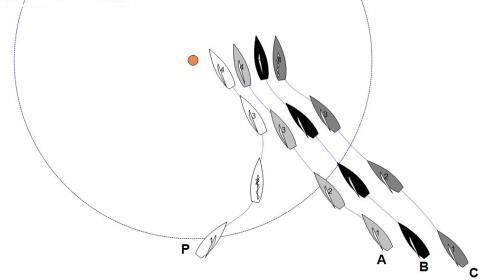
P passes head to wind from port to starboard. Rule 18.2 does not apply and 18.3 does. P reaches close hauled on starboard without any boat needing to take avoiding action. P does not break RRS 13 P initially gives A Band C room to keep clear as required by RRS 15. A Band C have been on starboard since entering the zone and are all fetching the mark. The second part of 18.3 applies. A luffs to avoid contact with P, B luffs to avoid contact with A and C luffs above close-hauled to avoid contact with B. P has caused C to luff above close-hauled and breaks RRS 18.3 Assuming A was in 1st place as she entered the zone. If P had passed astern of A, B, and C, and thus avoided breaking RRS 18.3, she would have rounded the mark in 4th place. So, after taking a penalty she should be in 4th place or worse. If noy she should take another penalty.
-
14(b) and 14(c) are entirely new and change the game considerably. 14(a) means that you shall avoid contact with another boat 14(b) means that you shall not cause another boat to make contact with another boat. For instance, when you luff a boat to windward, you shall not cause her to make contact with another boat. 14(c) means that you shall not cause contact between another boat and an object that should be avoided, for example the starting mark. This means that if you have a group of boats to windward and you luff in such a way that the boat furthest to windward hits the starting mark then not only have you broken RRS 16.1 but also 14(c)
-
While reflecting on the rules that apply if the RRS 20 'magic disappearing hail' interpretation is confirmed, a thought came to me. It concerns RRS 14 Avoiding Contact. At present a right of way boat that breaks RRS 14 is exonerated unless the contact result in damage or injury. Injury is very rare in radio sailing, and our boats are quite resilient. Would boats be more likely to avoid contact if exoneration for a right of way boat is not granted if the boats become disabled? This would mean that even if the entanglement was short the RoW would have broken a rule and need to take a penalty. In a particularly egregious case a judge or umpire can do something under the current rules... by establishing that the boat had broken rule 2, Fair Sailing.
-
One of the issues in radio sailing is the multiplicity of the rules that apply
-
Darin, Paradoxically, these elaborate structures are often constructed in the belief that they will improve competitor's view of the sailing area. This may be true when the wind is exactly in the right direction. Possibly the best venues are were the shore line is concave so that the bottom and top ends of the course can be near the shore. Foster City, Ste. Hilaire (on one side of the lake) and the Swedish venue for the DF65s ( a long pontoon with several changes of direction. Roganitza (not sure if I spelt that right) was good when sailing off the pontoon, not off the shoreline. Fleetwood has the great advantage that it is impossible to set a course with marks too far from the bank. Other venues were particularly difficult. I think that we should accept that there are not many venues that are suitable for the very top level events. I take your point on education - I would suggest that this should be seen as IRSA assisting the national radio sailing associations to train observers.
-
I agree with Brad. The role of the major international events in the radio sailing community is important, but must not lead to us forgetting that this represents a tiny proportion of radio sailing activity. These events are important because they provide a unique opportunity to talk to radio sailors from many countries, for sailors to encounter race officials. I always come away from such an event with a list of ideas and projects. However, our rules and our methods should be based on everyday racing not exceptional events. There is an issue in the WS process, in that the rule writers are predominately race officials who officiate at the elite end of the sport. We should be attentive to this. I would add, that is excatly why I initiated this conversation on this forum... to hear from the grassroot sailors. Unfortunately, there has emerged in recent years a number of race officials who are influenced by the practices of other sailing disciplines. We have developed several unique features in radio sailing that these persons do not seem to fully understand or agree with. For instance the involvement of observers, and especially the involvement of observers who are competitors. Radio sailing umpiring has always been based on the reality that umpires will not see everything, so there has to be way of bringing an issue or incident to the protest committee. Some umpires have difficulty with this. Others have difficulty accepting that an umpire's decision should e based on the information available to the competitor, so the umpire is required to stay in the control area. This difference of opinion lead to a crisis in which the Croatian Sailing Federation submitted (we presume with the cooperation of leading race officials) a submission that would have made umpired racing the default form of the sport, would have removed observers and allowed umpires to roam freely, on the bank or on the water. I would add that I do not always approve of the attitude and behaviour of some of my colleagues. I have, on occasion, thought about reporting a race official to World Sailing. Perhaps we should consider doing this more frequently. Anyone concerned can make a complaint. WS does take such complaints seriously . There are major issues with using raised platforms for the control area. The major issue is a lack of flexibility... the competitors are constrained in one area, and the race committee cannot move the race area to offer a sailable course. If the wind is not in exactly the right direction then the race committee will have difficulty setting a fair start line that competitors can see, and laying marks with the range of vision of the competitors. I think that the idea of recording repeat offenders is an excellent idea. I think that this can be done without a rule change. To finish with a rant: the class chooses the venue for its key events. When choosing the venue the sailing side of the event should be given priority. We have to face the reality that there are venues that are not suitable for major events. There are others that are suitable, even excellent, as long as the full extent of the bank, on both sides of the racing area. For instance at one event, when the control area was on the shore line marks were distant, and the afternoon sun dazzled sailors and race officials. When the control area was moved to the pontoon on the other side of the racing area these problems disappeared. The class and the club, as the organising authority, have the right, to tell the race committee .how to run racing. The race committee has an obligation to run racing as directed by the club and class. There are events at which the class has chosen an unsuitable venue, the race committee then compounds this by setting courses beyond the known limits of the human eye. The result is that neither competitors nor observers nor umpires can see what is going on. Calls are missed, or are made late. In these circumstances it can be demoralising, to say the least, to spend a week viewing distant dots on the ocean, trying to give some kind of service to competitors, and being criticised for declaring, in all honesty, that one cannot make a decision
-
Ian, The basic principle IRSA has adopted is that radio sailing should use the same rules as the general set of rules, unless those rules do not work for radio sailing. Other forms of sailing have changed many more rules. However, there are many rules that can be changed by the national authority or the event organiser. An example would be RRS 31 Touching a Mark. Appendix E does not change this rule. However, some classes, such as the RC Laser, and some countries, Spain, for instance, do change this rule to allow boats to touch marks. WS Radio Sailing Call discusses how mark-room applies when boats are allowed to boats to touch marks. The change to RRS 44 on taking a penalty allows a boat that has gained an advantage to continue taking turns rather than retire. As discussed in this thread, I do not think that the rules governing boats arriving at the windward mark on port really work. There are ways of increasing the penalty, but it would be better to fid a way of preventing problems arising in the first place. I also am becoming more convinced that RRS17, leeward boat not sailing above her proper course, is of little relevance in radio sailing.
-
I agree with many points made by Brad. The spirit of cooperation between ROs and umpires has degraded over the years. Feedback from Gladstone from an umpire: Gladstone had a small control area leg to observe the start and then the boats sailed mostly directly away from the viewing platform. The windward marks were consistently well over 100 metres away, but once were moved back on my request to 92 metres. However, for the next heat they were moved back to the original distance by the race officer. This resulted in only seeing the transom of port tack boats sailing into the windward mark and then losing the offending boat in the resulting melee. Right from the very first meeting I emphasised the success at previous championships of the windward gate in reducing the incidents at the windward mark. I continued over the first three days to reinforce this, but it was not until the after racing competitors meeting on the third day that it was finally introduced. When the marks were well laid it considerably reduced incidents and could have led to the marks being brought closer, but they were not. The starting lines were laid with a constant biais to the starboard end on lines that were almost at right angles to the control area making it difficult to identify incidents at the overcrowded far end. This was brought up at the after racing countries meeting day after day but the race team only attended the first of these and little changed. And from an organiser: I heard no comments from competitors regarding the marks being too far away at all. On two occasions, I was on the platform when Scott was setting the course for racing. On both occasions he spoke with the skippers who were practicing, asking their opinion on the distance of the marks. One time, the skippers said they were too far, and he immediately bought them back until skippers said they were fine. At no time during the skippers end of day meeting was the issue raised either. So from a sailing perspective, I felt the courses were not too distant at all. The top mark issues were helped by the gate, but the origin of the problem was the disrespect by many skippers of the racing rules, not the distance. The reason for the use of the boat was not to identify infringements, but to attempt to identify sail numbers promptly for communication to the skipper. The Jury (other than the Chair ) were inexperienced in radio sailing. They could have identified boats by hull colour, deck patch colour, sail markings, location on the course or movement at the time ( the boat gybing now) to alert the skippers prior to viewing the sail number but they were not doing that. A couple of the Judges were a complete waste of money. (two) didn't open their mouth all week. (One) asked me how I could tell which gybe the boats were on. (redacted to ensure no untoward reference to specific persons) Reading these two reports one questions whether they were at the same event. The compromise, at this event, was that a RC crew at the windward mark would identify boats that had been hailed by an umpire. They were not always available. We shall see what happens in Croatia. At the last major event sailed there, marks were a long distance from the control area and, in the afternoon, the windward mark was straight into the sun. I would suggest that there are only 2 ways to resolve this issue: - set courses within a comfortable distance from the control area - allow umpires to leave the control area to observe racing. For logistical reasons this would almost certainly mean that the dialogue between umpires and competitors would not be possible. No hails of contact, no hails of protest and no voluntary penalties. Instead the officials would become referees, penalising every infringement that they see. I am not convinced that radio sailors would welcome this development.
-
Appendix E already changes the Racing Rules of Sailing. Other branches of sailing that have their own Appendix do change RRS, in order to make the game possible or better, or to adapt to the particularities of the boats/boards. Examples include the size of the zone, the concept of a disabled boat, multiple penalty turns instead of retiring, no course changes, observers... Another change is with starting penalties: Appendix E deletes the Z flag penalty. This leaves the I flag (round the ends and the U and Black flag. These give tools to the Race Committee to deal with fleets that do not manage to start correctly. These tools are to be manipulated carefully. The I flag RRS 30.1, has fallen out of favour, as it is felt that it encourage boats to avoid the middle of the line, in effect making the problem worse. The U flag has become the standard starting penalty in big dinghy fleets. IRSA's policy on the use of starting penalties is the same as World Sailing - they should be used only when the RC is certain that the recall was not due to a poorly set line or a RC generated issue. In the event the start has been postponed, or a General Recall has been caused by the length or angle of the starting line, the course management team will adjust the starting line and make another attempt using the same preparatory signal. If the course management team is satisfied that a General Recall was not the result of the length or angle of the starting line or a course management team action, it will signal the use of a rule 30 starting penalty (I flag, U or black flag) for each subsequent attempt to start the heat An important principle to be followed by the course management team is that rule 30 starting penalties will only be used when general recalls are caused by the boats themselves, or rapid oscillations of the wind, and not by actions of the course management team. The penalty for being UFD and BFD under HMS may seem severe: one more point than the last boat in the lowest heat would have scored if all the boats competing in the event had finished correctly. HMS is supposed to reproduce as far as possible a race sun in a single fleet. In a dinghy/keelboat event that is the penalty for being disqualified, including not only UFD, BFD but also OCS. However, this is a rule that could be changed under HMS.

