Mark Nicoll
MYA Member
-
Joined
-
Last visited
-
If the PDF doesn't print well let me know and I can send jpegs or a word doc. Mark
-
Hi Simon , dont know if this helps but here is that Tony Abel brochure from 1996. I may be wrong but take a look at the Cygnet on page 5, it does look very similar. Even if it doesnt help its a good read with the prices and design of kit back then. Take care Mark Tony Abel Brochure.pdf
-
Apologies Larry, no intention to put you on the spot in your position. Take care Mark
-
So I am playing devils advocate here, how does a small well beside the mast differ to a larger well behind a stepped foredeck. One is just a flattened and smaller version of the other. In the rules is one prohibited and the other permitted. Dont get me wrong, I think what I am proposing is not within the spirit of the rules, and certainly not what I intend to implement on my boat, but I have found in sports I have been involved with in the past, any loophole or undefined limit is often used if people believe it could gain an advantage. Take care Mark
-
Thank you John, I think its interesting that we understand the point of the deck limit mark and its use fully, but dont seem to have a defined rule as to its position. Maybe its my assumption but the change in design from flat decks to stepped decks with wells and now it seems raised rear decks has all been to get the mainsail to deck distance smaller. This has led to complicated deck designs and access to the inside seems to be keyhole surgery. I wonder how many people now sail with boats that were built on the kitchen table. Mine was a simple fibreglass hull with a flat wooden deck. This was cheap to build and manufacture. Will it win every race, certainly not, but there is no doubt I make more mistakes that lose me a race than my boat design does. My challenge has been to get the most out of a 28 year old flat deck design and in that process learn as much as I can. When I started I was last to the first mark on every race. Now I am beginning to get to the mark in the middle or towards the front of the fleet and sometimes I even keep up to the finish I am now asking these questions as I am updating all the rigs from the 28 year old sails and masts I am currently using and am looking at the best way to lower the mainsail within the current rules. As John Ball said there is no rule that does not allow a portion of the gooseneck below the deck limit mark and I will go with that as it is the simplest way for me to get the mast lower limit to 60mm. But if you could lower the deck limit with just a small well could a flat deck boat be built on a modern hull design, that was simpler and cheaper to manufactuer, and yet still be competitive? Take care Mark
-
Thank you John, I think its interesting that we understand the point of the deck limit mark and its use fully, but dont seem to have a defined rule as to its position. Maybe its my assumption but the change in design from flat decks to stepped decks with wells and now it seems raised rear decks has all been to get the mainsail to deck distance smaller. This has led to complicated deck designs and access to the inside seems to be keyhole surgery. I wonder how many people now sail with boats that were built on the kitchen table. Mine was a simple fibreglass hull with a flat wooden deck. This was cheap to build and manufacture. Will it win every race, certainly not, but there is no doubt I make more mistakes that lose me a race than my boat design does. My challenge has been to get the most out of a 28 year old flat deck design and in that process learn as much as I can. When I started I was last to the first mark on every race. Now I am beginning to get to the mark in the middle or towards the front of the fleet and sometimes I even keep up to the finish I am now asking these questions as I am updating all the rigs from the 28 year old sails and masts I am currently using and am looking at the best way to lower the mainsail within the current rules. As John Ball said there is no rule that does not allow a portion of the gooseneck below the deck limit mark and I will go with that as it is the simplest way for me to get the mast lower limit to 60mm. But if you could lower the deck limit with just a small well could a flat deck boat be built on a modern hull design, that was simpler and cheaper to manufactuer, and yet still be competitive? Take care Mark
-
Many thanks John for this it will allow me to get the mainsail as low as is legal. Out of interest do you know how a deck limit mark is defined in terms of position? Is it just the lowest point of the deck beside the mast? Take care Mark
-
Sorry Simon, I totally forgot I will look at this when i get home this weekend. Take care Mark
-
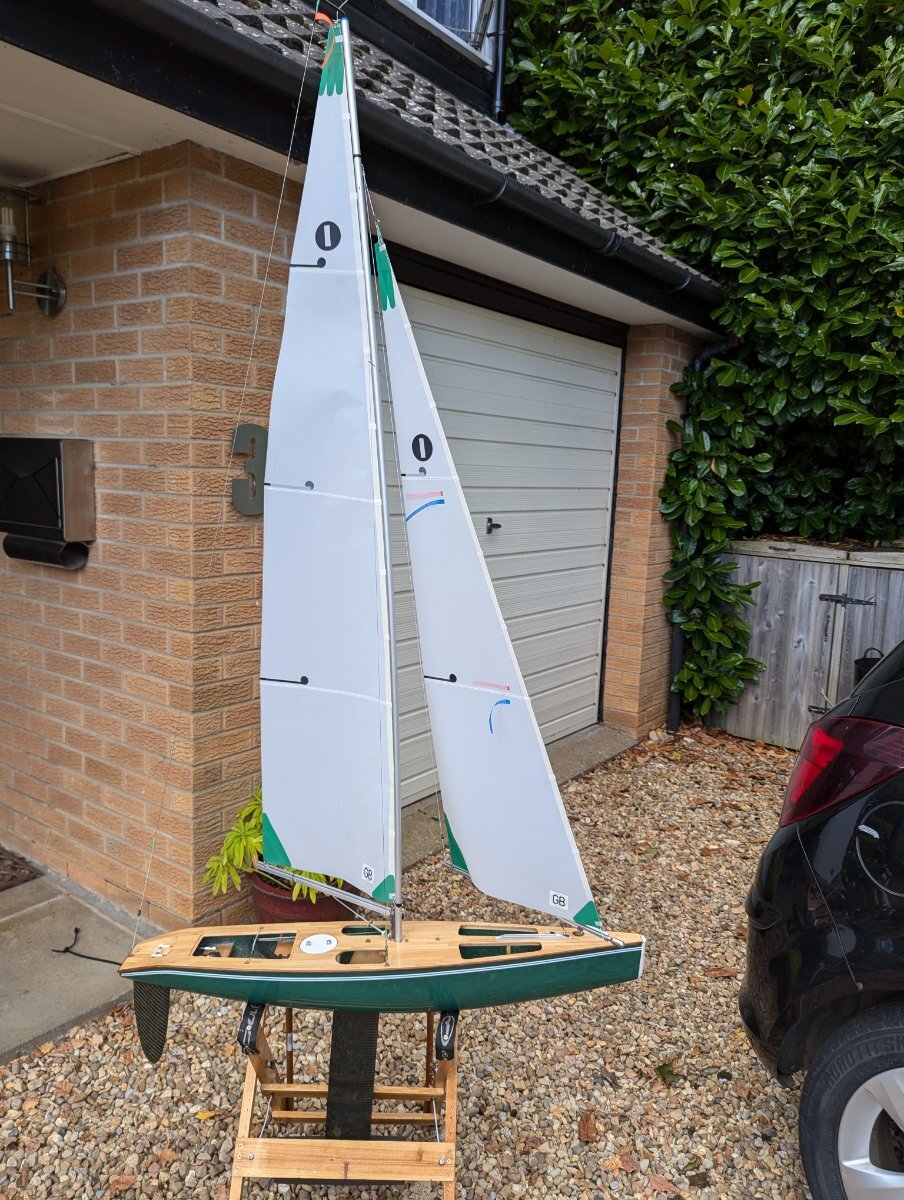
Hi all, I have been slowly improving a Tony Abel Mandarin boat over the last few months. I first started with new new bulb and fin, and now I am now in the process of updating the rigs. Ive lowered the jib as much as possible and am now looking at lowering the main boom. Lower limit on the mast is at 68 mm. Being a flat decked boat the deck limit mark is just fore of the mast slot, which is approximately 23 by 11mm in size. With the new fin the mast is in the front of this slot. I would like to get the main boom as low as is possible but my gooseneck is about 65mm long. So my questions are: 1. Does shortning the body of a gooseneck change the angle of the kicker to boom and therefore change the pressure on the leech to twist off or is it self balancing and you just allow for it in set up. 2. Am I allowed to drop the screwhead of the gooseneck below the deck limit mark. There is enough room for it to swing without fouling. This then allows me to bring the lower band to the 60mm mark. 3. Because I like to change things and be mischevious, and Mandarin being a wooden deck this would be really easy, would I be allowed to put in a small well. This would be about 2 cm diameter and 1 cm deep behind the mast in the deck that would allow me to drop the gooseneck further and then place the deck limit mark within that well. I'm not sure its in the spirit of the rules but was just interested I know these may seem stupid questions but i was just interested as I could only find Rule D1.5 re the limit mark. I am sure there must something elsewhere but I couldn't see it. D.1.5 DECK LIMIT MARK The deck limit mark shall be displayed on the centre plane of the hull near to the mast position. It shall be a minimum of 5 mm in diameter. Feel free to criticize my mistakes, i wont take it personally, as its often the quickest way I learn Take care Mark
-
Hi Simon, I still have a catalogue from when i bought a Tony Abel boat in 1996. I will scan it to see if it is in there. I have just restored the boat I bought that was sitting in the box for 28 years. Some of the IOM designs that he built were Cygnet, Mallard, Swallow and mine that was a Mandarin. I might be wrong but I suspect its pre 1996 as he was using carbon fins and rudders by then, but it was the choice of the purchaser. Either way I will look when I get home at the weekend. In regards to performance is it as fast as modern boats .. no. But it is a great way to learn how the rigs work there and sailing techniques you need before moving up. The fast boys only need to make a mistake.............. Take care Mark
.thumb.jpg.d5ba79ab467ce0b5c3bded2edb955e5c.jpg)
.jpg.79537357c35c86827dd0973eb84ddbee.jpg)