All Activity
- Today
-
If we must have a windward gate (not a big fan) then maybe we should just have both windward marks as port rounding, for the obvious reasons.
-
Vision IOM GBR 4760 built by Phil Playl with RMG 280ES winch absolutely stunning condition with current measurement certificate comes with, No1 Rig French PG 11mm mast/boom Sailsetc ballraced gooseneck and fittings Catsails sails. No2 Rig French PG 11mm mast/boom Sailsetc gooseneck and fittings plus ballraced jib fitting, Catsails sails. Flawless fin/bulb and rudder Rig box included Just add radio gear and go sailing! £1250.00 Private message for contact details.
.thumb.jpg.3bd1a81a397342956cfd1b00898e9614.jpg)
.thumb.jpg.39264848f6ab398030c17faea91d380f.jpg)
.thumb.jpg.433b565ef4a471a3171f9d46a719033b.jpg)
.thumb.jpg.4fcb9465046dbca40a6a5367b9134f0c.jpg)
-
Good afternoon, Is the boat still available and if so, where in Dorset are you? Also, is your price negotiable? Many thanks. R.
-
Thank you Derek for pointing us in the direction of one key point in the discussion. He refers to the issue of identifying boats. Many of the issues encountered at the windward mark disappear or are significantly reduced if all sailors and race officials can see what is happening! If all participants can easily read sail numbers this means that they can also better judge: Laylines The distance between overlapped boats Whether boats are on a collision course When the marks are set too far away, umpires and observers spend a great deal of time just trying to read sail numbers, in case there is an incident. This is especially the case for the umpire watching the far end of the start line. At Datchet there was hardly a start at which umpire and observer could read the sail numbers of boats beyond the outside start mark. There are particular issues at the windward mark when it is set more than about 65-70m from the control area and the fleet is sailing from right to left. Boats on port are sailing away from the shore and the sail number is invisible. The boats approaching on starboard cannot judge accurately if they are on the lay line, above it or below it. So we have, for the observer or umpire, two orn more unidentified boats heading towards the area around the mark (NB, in certain lights at Datchet even hull colours were difficult to see). The worst pile ups at the windward mark in these conditions are frequently caused by the starboard tacker, realising, when they have already entered the zone, that they are below the layline. If they are only slightly below, they may attempt to luff, causing boats outside and astern to also luff and slow, even stall. Otherwise the boat (still unidentifiable from the control area) will tack and aim for a gap that may or may not exist. If the gap does not exist, chaos is almost guaranteed. Even if the observers and umpires can follow the (unidentified) boat until the sail number is legible (often just before or after the offset mark) the damage has been done. The race has been ruined for several boats. There is also an issue with umpiring culture. Umpires will not penalised a boat unless they are certain that the boat has broken a rule.They will need to be even more certain before giving a penalty under RRS 2, Fair Sailing. The obvious solution is to lay marks closer to the control area. This creates other issues, as race officers wish to set a balanced windward leg. When the course is close to the shore, both sailors and race officials can see what is happening. The number of incidents is greatly reduced, and the percentage of incidents resulting in an umpire decision increases. So, when choosing a venue for a major event, a key criteria should be 'can the race committee set courses in all (or at least the most frequent) wind directions with marks less than 65-70m from the shore?' I have come to believe that there are very few venues that can met that criteria. I have been to a few venues that did meet that criteria - Fleetwood (the lake is only 62m wide), Limone (on Lake Garda), Nynasham I hope I spelt that right,) (Sweden , DF65 Globals), Ste Hilaire (only on the far shore, but the distances to walk were enormous) to mention a few. One issue in Datchet, as an umpire I was making a concious effort to walk up as far as possible to get close to the windward mark, to get as near as possile to the leeward gate and to get to the finish line. At most events I would be close to at least the better sailors in the heat. This was far less the case during the Worlds. In particular, many sailors were standing well to leeward of the finish line. I remember one leeward gatemark rounding where there were only 1 or 2 sailors with 50m of me. I think I hailed 4 mark contacts and note 2 marks not rounded. I am fairly sure that the competitors, from where they were standing, did not see the mark contact.
-
I have a Futaba 7C Transmitter and R617FS Receiver for sale complete with manual and original box. Asking price £100. I also have additional Receivers for £25 each. Contact by email. tp.mbryc@yahoo.com Leicesteshire area
-
FLEETWOOD MODEL YACHT CLUB A WEEK & THE CRABBERS Those who attended the Vane A Nationals at Fleetwood in 2024 will remember the problems caused by boats fouling crab lines and sailors struggling to attend to their boats on the bank due to families populating the bankside. In order to try to remove this problem, we at the club have consulted with council officials and obtained permission to “rope off” the lake as much as possible and erect notices to the effect that from Sat 25th July to Sun 2nd August the Model Yachting lake is closed and “crabbing is in the boating lake” There will be at least 20 of these A3 sized notices placed around the lake and at the entrance to the carpark, and on the walkway to the bridge. We hope that competitors will understand that we, the club, with the support of the council are doing everything we can to solve this problem. Thankyou for your understanding. We look forward to welcoming you all to our “9 days of A’s” vane & radio A regatta. Derek Priestley Fleetwood MYC
-
Same answer as Derek, approach mark doesn't help, it just moves the problem.
-
Gents, Nowhere in this discussion have you mentioned the common problem where, with WW & spreader, the incidents where 1 lucky boat gets away and the rest is just a pile up caused by port boats not giving way to stbd. I agree that a mark say 6 lengths to leeward will reduce the problem at the WW mark, but it still creates the same problem at the new mark. (Believe me I've tried it several times) Until the umpires start giving some Rule 2 DSC's to the port boat chancers, (if they can identify them) the problem will never go away.
-
Hi Nigel, welcome back to Fleetwood. the NOR is being prepared and will be posted soon. Then you can enter and have your spots!! Looking forward to seeing you. D
- Yesterday
-
Finley Dickinson joined the community
-
Ben Grenger joined the community
-
Steven Marriott joined the community
-
Mervyn Watson joined the community
-
Annabel Taylor joined the community
-
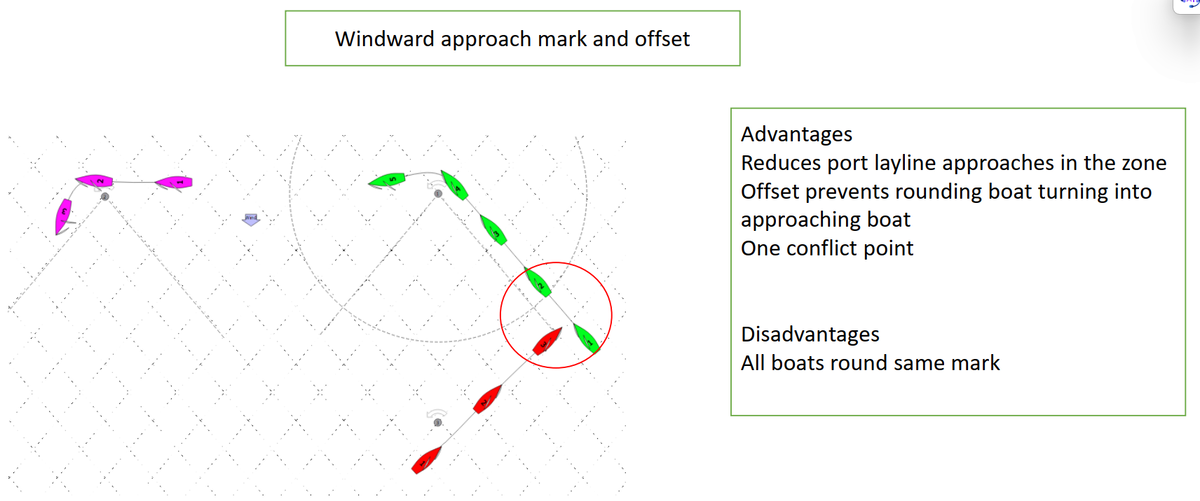
I suggest another option for consideration - use a wind mark and offset mark with the addition of a windward approach mark. The approach mark would be set about 6 boat lengths to leeward of the windward mark and have a required side that all boats must pass it to port. The idea is that boats coming in from the left side of the course on port, would be encouraged to get on the stbd lay line sooner, and if possible, outside the zone. John

-
I have sailed last IOM Worlds and I have watched last day of M Worlds with inside out + spreader. Outside in gate is somehow dangerous when boats downwind cross boats upwind just after the mark, but it reduces the incidents at windward mark(s) compared with classic spreader. My opinion is to avoid this option if gate is far away and if there is a lot of wind and use usual spreader. If boats are far and fast, you risk hits, and strong ones. Inside out + spreader is maybe the best option to avoid incidents, but : 1/ it's a nightmare for mark layers to get something fair 2/ Boats are so much separated at the beginning of the run that if you are on the wrong side, you are dead... The same without spreaders is easyer for mark layers, but you still have to go around windward boat on the layline before going downwind. So course is somehow shorter for boats not leading. To use Gordon's questions : and comparing with classic spreader Outside in reduce the number of incidents at the windward mark => Yes distribute or concentrate the fleet at the start of the run => Similar allow boats to bail out if they mis-mis-judge the lay line, or which to avoid a congested mark => Yes facilitate the work of the observers and umpires; => You would know, probably easyer as boats are separated facilitate the setting of fair courses. => No Inside out + spreader reduce the number of incidents at the windward mark => Yes distribute or concentrate the fleet at the start of the run; => Distribute (too much) allow boats to bail out if they mis-mis-judge the lay line, or which to avoid a congested mark => Yes facilitate the work of the observers and umpires; => No, more marks to check facilitate the setting of fair courses. => No, worse of all
-
I have a ferry I have accomodation Now I just need a spot (actually two) on the entry list. 😄
-
At the M & 10R Worlds we raced with the "classic" windward mark / dog leg, a windward gate inside out and finally the gate plus spreader marks. I didn't sail the IOM Worlds but have sailed multiple regattas incl. the last German M nationals with the outside in gate. The outside in gate is my least preferred option. If you are at the front of the fleet this creats a choke point where you are forced through the middle of the course with boats approaching / crossing from both sides on their way to the respective side of the gate. The videos of the last major IOM events provide a host of examples where front runners loose numerous places due to incidents caused by bunching up all of the fleet. The inside out gate in France worked well (allthough some managed to forget about the spreader and were DSQed multiple times) as it separates beating and running boats and was tactically challenging. However, depending on the lay of the land, the course and prevailing wind a windward mark with dog leg can work just fine.
-
No PRO/umpire experience from me, not even that much RC sailing. My racing is typically a single spreader, though an outside-in was also used at our Open this weekend. One thing I sense though is that the efficacy of any method can still be upset by the angles. It's not always practical - esp. at events lesser than the Worlds kinda level - to be moving marks constantly, but a heavily shifting wind can result in laylines wandering such that any method can end up messier than the 'theory'. And of course the distances between multiple marks, and even distance/bearing from Control Area. A degree of 'horses for courses' perhaps, or [apologies for any earworms] 'it aint what you do, its the way that you do it'..?
-
Is there anyone on this forum who atended bothe the M/1OR Worlds last year and the IOM Worlds this year? If so I would be very interested to read their opinion on the windward gates used: M/10R: inside out gate with offset marks on both sides of the gate IOM: outside in gate In particular I wish to know if, in your opinion, different gates: reduce the number of incidents at the windward mark; distribute or concentrate the fleet at the start of the run; allow boats to bail out if they mis-mis-judge the lay line, or which to avoid a congested mark facilitate the work of the observers and umpires; facilitate the setting of fair courses. As a judge/umpire a both events I have a personal opinion which I wil reveal if this thread has some replies. I may well be that my opinion will be very different ffrom that of competing sailors.
- Last week
-
Colin B joined the community
-
Paul Deane joined the community
-
michaelmorris joined the community
-
I've run an extension/ charge lead up to the small patch hole and just cover this with some clear duck tape. The main patch never comes off. The lead is wedged up with some foam in the hull so the end of it doesn't get lost in the hull.
-
I recommend against charging Lipo or Life batteries in the boat- risk of explosion or fire. I always use a charging safety bag. John
-
Where are you based please Luke?
-
Surprised that I have yet to find a solution for charging the battery on a DF65 without removing the adhesive patch. Has anyone found or is using a suitable 2 pin connector that could be let into the plastic stern cover with a waterproof outer cover?
-
Elliot Hanson joined the community
-
Jonathan Gillmore joined the community
-
The IRSA Race Management Policies state: General Recall 8.1In case of any problems with the starting line (such as length, or angle to the wind,etc.) a postponement may be signalled, even up to the last second before the start, instead of a general recall. 8.2 If a race management error is discovered after the starting signal (e.g. timing), the course management team may abandon the race. In these circumstances, the course management team will not signal a general recall. 8.3 When the course management team is not satisfied that all boats over early (or that have broken rules 30.1, 30.3 or 30.4) have been identified, a general recall will be signalled. 8.4 In the event the start has been postponed, or a general recall has been caused by the length or angle of the starting line, the course management team will adjust the starting line and make another attempt using the same preparatory signal. 8.5 If the course management team is satisfied that a general recall was not the result of the length or angle of the starting line or a course management team action, it will signal the use of a rule 30 starting penalty (I flag, U flag or black flag) for each subsequent attempt to start the heat 8.6 An important principle to be followed by the course management team is that rule 30 starting penalties will only be used when general recalls are caused by the boats themselves, or rapid oscillations of the wind, and not by actions of the course management team. 8.7 When using the black flag, the course management team will make every effort to signal a postponement in the event of any problems with the starting line. These policies closely mirror those of WS.
-
This is the fundamental flaw of the outside in windward gate. At the M/10R Worlds last year the RC set an inside out gate with offset marks on each side of the gate. Once the sailors had worked out how this worked there was a significant reduction on incidents at the mark. Few boats attempted an approach on the port layline. Instead boats approached on the starboard layline of both marks. Boats that came up the left hand side of the course would sail to the left hand mark layline. Boats on starboard would form two queues along the layline. One advantage is that if there was an issue ahead it was always possible to bail out at the last moment by heading for the other mark (either by tacking or bearing away). This is an advantage when the marks have to be set some distance from the shore. As boats arriving to the right-hand mark had to tack to round the mark, the RC set the offset leg on that side slightly shorter
-
I may have copied 7 rigs worth of settings onto my spare by then !
-
Thanks John - left stick issue….
-
Thanks for the suggestions- my thought was the pot on the transmitter so will try another channel.
-
As suggested, first try the winch in another channel. If it still does it, then dirt / corrosion / damage in the winch feedback pot is most likely. If you can dismantle the winch and spray contact cleaner onto the track, then this might cure it. The problem is that having gone bad once, it is likely to do it again. If it's an RMG then replacing the pot is fairly easy (though expensive for the older 10 turn types). For other types, manufacturer's spares are hard to come by and finding a generic part that fits properly is also tricky. Depends how seriously you sail, but a new winch and keep this one as a spare might be the best option for a non-RMG.


.jpg.e3bcadfbcb785cdb9f4a7508a828dffa.jpg)
.jpg.e049d4ca2f1b7b6df688c3f8838008d2.jpg)
.jpg.bd50dde17497c5c9e8834bcd669273a1.jpg)
.jpg.4d1045623850eb28ce84f3a160bdfc9c.jpg)