Gareth
MYA Member
-
Joined
-
Last visited
-
Dimensions would help to identify it but its certainly not a Marblehead.
-
Graham, I have a copy of the Genie drawing but the area showing the sail plan is quite faint and the table showing the sail dimensions has a discrepancy with respect to the sail plan. Based on the table the sail dimensions (in inches) are as follows:- Suit Luff Leach Foot A 50.0 47.5 12.75 Jib B 45.0 42.0 14.0 C 37.0* 33.0 14.0 * This dimension is 39.0 on sail plan drawing A 75.5 76.5 13.2 Main B 59.5 61.5 17.0 C 48.0 50.5 17.0 Scaling from the drawing the main boom is approx 4.0 inches above the deck The main mast dimension is given as 56 inches, top mast for top suit, 26 inches. top mast for working suit 12.5 inches, smaller suits use main mast only. The mast head/jumper strut section is 2.5 inches long giving a maximum overall length of 84.5 inches. Scaling from the sail plan drawing the longest overall mast length is shown as 85 inches which is pretty close to the total of the individual sections. Regards, Gareth
-
Hi Peter, I have made a number of polythene spinnakers mostly scaled from the one that came with my Marblehead Skippy. The pattern I have used is shown in the attached diagram. The spinnaker pole I use with my 36R is 14.75 inches long. I found the best way to experiment, since I live a long way away from anywhere suitable for free sailing, is by setting the yacht up on a stand in the garden when the wind is in the best direction for a steady speed and turning the yacht to see how the spinnaker fills. See you at Fleetwood in May hopefully, Gareth Spinnaker1.pdf
-
I have a panelled Daron main sail which I need to trim as the roach fouls the backstay by about half an inch. I cannot really move the back stay as its position is a compromise between clearing the sail roach and the vane gear. The backstay crane is already as long as I think is reasonable. What is the best method of trimming the roach of a panelled Dacron sail? I have an electrically heated stencil cutter which I have used in the past on Dacron sails but its difficult to achieve a neat smooth edge. Could I use a sharp pair of dress makers scissors or a scalpel, bearing in mind the sails will not get a great deal of use and generally will only be used in fair weather conditions? Any advice gratefully received.
-
Wayne, If you are going to the Fleetwood Vane Marblehead event in May I will bring the moving carriage vane gear with me.
-
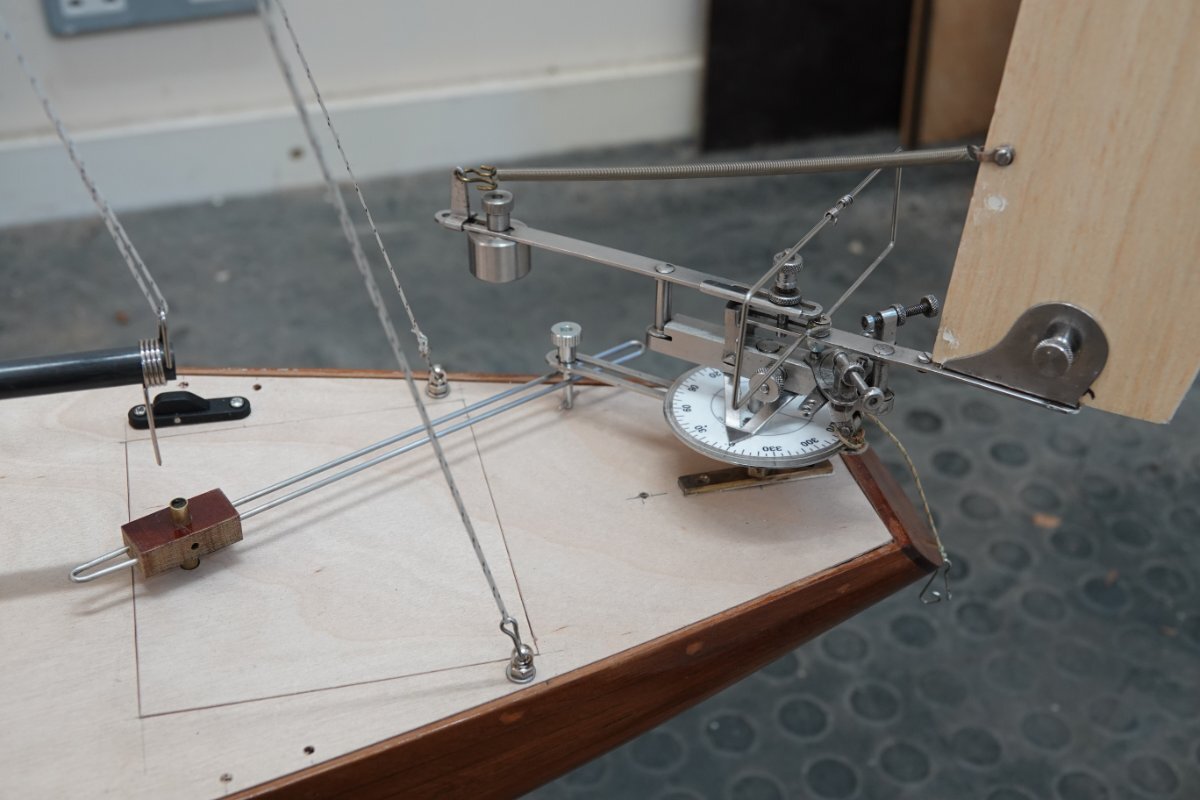
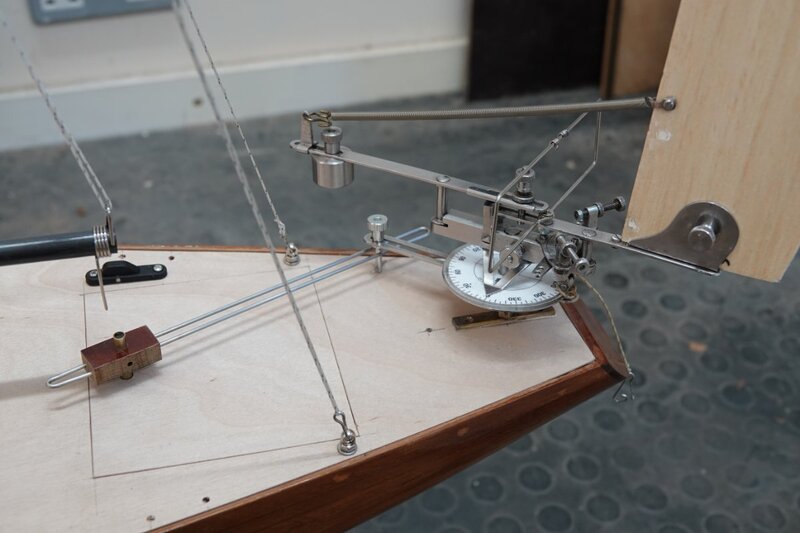
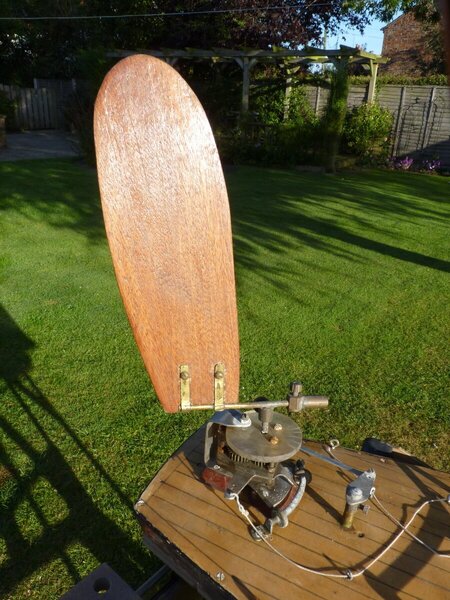
Wayne, Your Corby gear seems to be missing a bit. Ours has a small quadrant and a pair of adjustable stops to set the broken travel independently on both sides. It came from the estate of John Gale, along with the partially complete A class hull Serica 2/3. I have modified the guying set up and the dial. It sounds like you have not acquired a moving carriage gear yet. I acquired one with an old 36R but never got it to work satisfactorily. It's sat in my workshop in bits if you want it to experiment with. Gareth
-
Claire, I edit the Pondside Marketplace newsletter which goes out to all VMYG members listing any boats, books or other items members would like to advertise for sale within the Group. I have not been asked to advertise a yacht like Pat so I have no idea of its whereabouts but I could put a 'Wanted' advert in the next edition which should go out early in February. Let me know if you would like me to do this.
-
Mike Please note the following comments are my understanding of the MYA rules and I may be wrong, but if so, hopefully someone more knowledgeable will correct me. Unless you want to race the 10 Rater competitively I don't think there is much point in doing anything. There is nothing to prohibit you sailing the yacht as it is with the current registration number. I currently have a vintage 10 Rater and an A Class in the same situation If you want to transfer the yacht to your name and you have the original certificate and the yacht still complies with it, I think you can complete a form to transfer ownership to you on the 10 Rater register. If you don't have the previous certificate I believe the yacht will have to be remeasured and a new certificate issued. However since it has previously been registered it can be checked in accordance with the rules in force at its original registration date, rather than the current ones. You could join the Vintage Model Yacht Group and use that as a source of information but we have no authority to register vintage yachts. We hold sailing meetings around the UK and I think the nearest ones to you would be at Birkenhead. The VMYG contact there is Andrew Peters. As far as I know there are no competitive events for Vintage 10 Raters at present. Charles Smith is the VMYG historian and has digitised some of the old registers including the 10 Rater one. He might be able to help you trace the history of your yacht if you contact him. Gareth Jones
-
Larry, Thanks very much I have passed the info on to our leadership. Gareth
-
Mike, Unfortunately the software for the VMYG website is obsolete and it is no longer practicable to keep the site updated. Investigations into a new website are ongoing. The contact details for the Chairman and Secretary are still on the website but if you have any problems send me a private message. I am one of the coordinators for the northern section of the VMYG. There is a VMYG Facebook page but that is only accessible to members. Gareth Jones
-
Steve, The advice from Graham was as follows, paraphrased somewhat. Imagine the ballast weight lying on its underside on a flat plane. When installed on the yacht, that flat plane should be parallel to the waterplane. I have taken a couple of photos showing the rough ballast to illustrate the issue. I placed a steel rule alongside the ballast, propped up at one end to what looks like the angle of the ballast horizontal axis. I then worked out the tangent of the angle and thus the angle itself. I think it gives an attitude of about 2 degrees nose up, but its difficult to be precise because there is no clear datum line along the edge of the ballast. The casting split line gives some indication where the horizontal axis is.


-
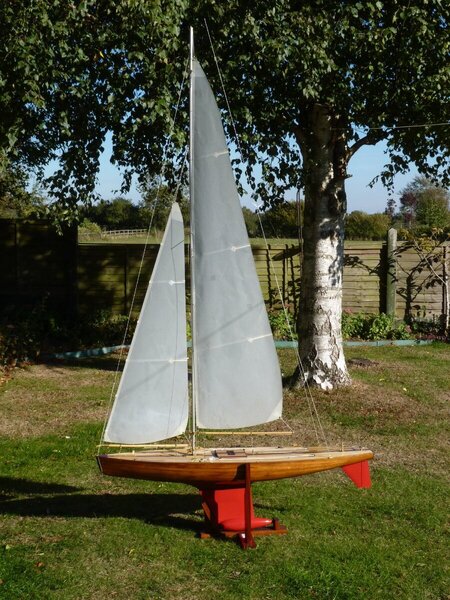
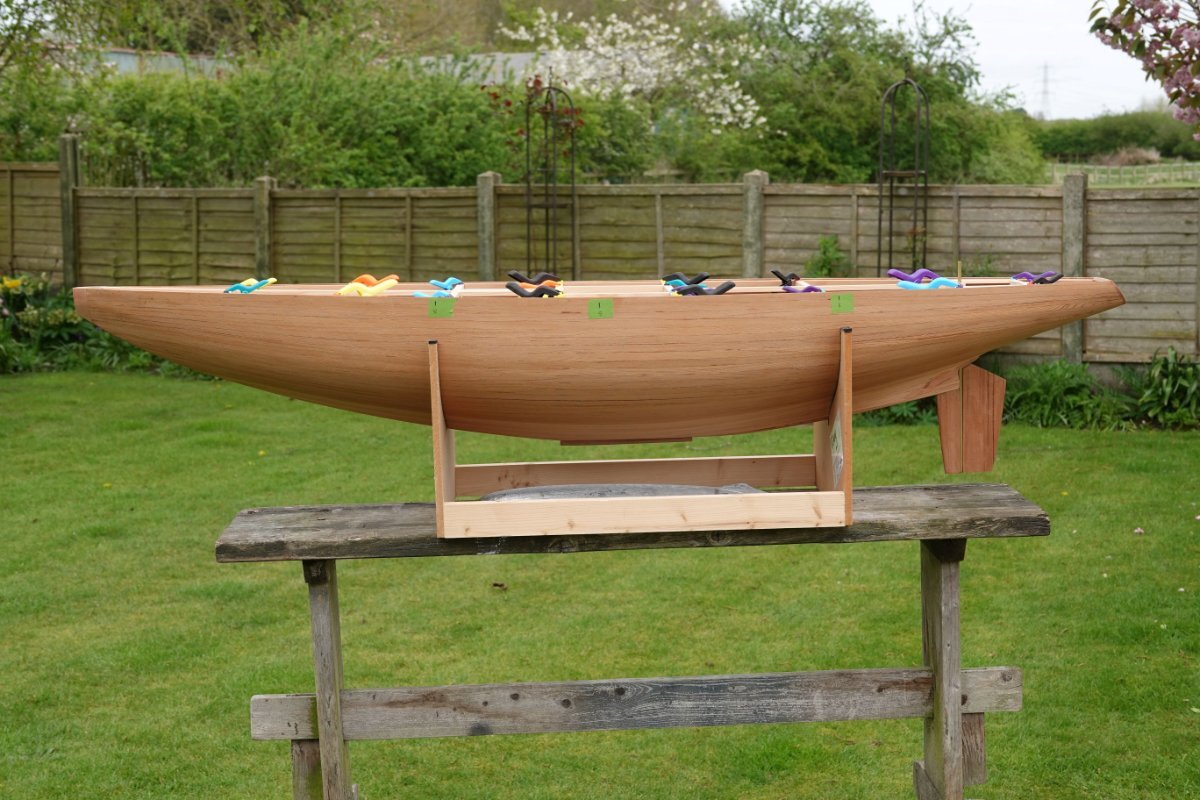
Thanks for that Bill, I have had some advice from Graham and should be OK in fitting the ballast. I am also taking some other advice from Graham to make the skeg detachable so that when sailing with radio control it will have a balanced rudder as the original John Lewis design. The skeg and rudder shown in the photos above will be used when vane sailing.
-
After an 8 month hiatus where I was banned from my workshop in order to prepare for a possible house move, (which has now been abandoned), I have started work again on my modified Petrel 6M. The next question for the 6M experts out there is what incidence should I aim for on the ballast weight and what on the ballast do I take as a horizontal reference axis? Its a Sails etc wide delta planform unit and looks about right just resting on its lower surface. However it need quite a bit of smoothing and finishing yet.


-
Wayne, On the US Vintage Model Yacht Group website there are some patterns for various types of spinnaker. You do have to scale them to a suitable size but I have made a few Marblehead and 36R spinnakers up using polythene sheet and double sided tape. Elizabeth went over the taped seams with a zig-zag stitch on her sewing machine. There is a link to the article here:- https://usvmyg.org/boats/sails/the-spinnaker/
-
Wayne, I am pretty sure you are correct in thinking the yacht is not a Roger Stollery Daredevil. We have one and it does have a sharper bow profile and also a straight edge to the skeg, unlike yours. I have attached a couple of photos. Your Marblehead does have the look of a Stan Witty design, possibly a Typhoon but has a curved leading edge on the skeg. The curved leading edge of the skeg is a characteristic of some of the Witty Marbleheads, eg Skippy, but not the Typhoon. However these aspects of the design are often open to interpretation or adaption by the builder.